Open to the irritation, grit forms a pearl it’s been said. Fish for mermaids, dive for pearls . . creativity@maryannmoore.ca
Twenty-Five Days

Twenty-Five Days

It’s been ten years since I had cancer which makes it time to celebrate that milestone of Ten Years Cancer Free!

Following a biopsy on my shin which revealed that the lump was spindle cell sarcoma, my GP in Nanaimo told me there would probably be some treatment and surgery. That didn’t sound too bad.

Then Sarah and I went to meet the orthopaedic sursgeon at the BC Cancer Agency in Vancouver.

Ravenous

Because the surgeon bears an impish grin
and pulls himself closer to me on a wheel-less
stool – he looks me straight in the eye
long enough to know he sees me –
and because he wears a mauve shirt with
co-ordinating tie, directs my gaze to a wall
calendar and says,
This will all be over in five months,
I accept his prescription:
five weeks of radiation,
six weeks of rest,
surgery in November.

We leave the office, walk slowly to the car.
Let’s just go home, Sarah says.

Because our home is across the Salish Sea,
we drive, silent, to the ferry. In the line-up,
Sarah goes for take-out fish and chips.
When they arrive, I eat them. Ravenous.

Five weeks of radiation on my left shin sounded ominous but it all worked out. I stayed at the Cancer Society Lodge near Royal Jubilee Hospital and the BC Cancer Society in Victoria where I had the treatments. The radiation technologists were friendly and efficient. Radiation isn’t painful; I just had a red burn on my left leg. That didn’t stop me from exploring Victoria where I’d walk in a different direction every day.

Twenty-Five Days

Every day after breakfast,
not always the same time,
I sign myself out at the front desk
of the lodge where out-of-town
cancer patients stay. Walk
down the steps, turn the corner
onto Richmond –
always
on the same side so I can
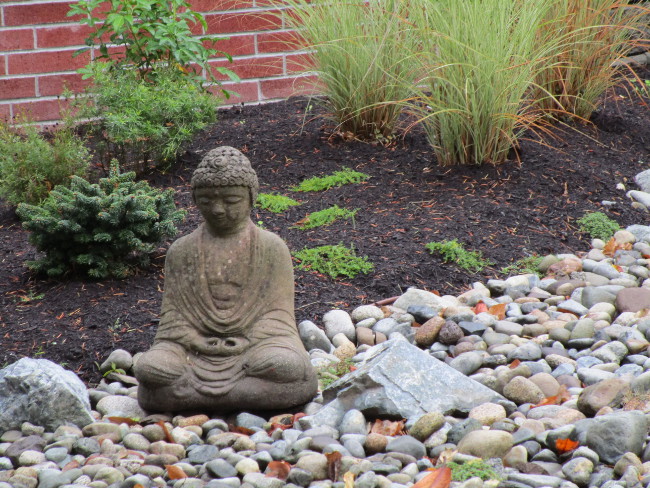
pause at the house with Buddha
in the garden – then pass the bus stop
where no one makes eye contact.
Inside the clinic, after the café and
the gift shop, I head downstairs.
A man stops when I come near, says
it’s bad luck to pass on the stairs,
presses his body against the wall and,
gives me a nod. I know where I’m
going. Through the waiting area,
peach and lime-covered chairs,
down the hall of donated paintings.
I put my white card in the tray
that says Fir. Sometimes I don’t
wait at all. When they’re ready
for me, I take off my shoes and
socks, roll up my left pant leg.
Hannah says, “Good morning
sunshine.” I shimmy into position
on the table. “Two to the right”
an RT says as they line up the
machine, place a pink bolus
on my shin. Hannah covers me
with a warm blanket. I don’t
remember the name
of the 6-million-dollar machine
even though I’ve stared up at it
twenty-five times. I close my eyes,
see my dead mum and dad doing what
they can to say everything will be all right.

My mother had died in 1995 and my father in 2014, a year before the radiation treatments. His wife Jean told me that if he had found out I had cancer, it would have killed him. Both my parents died of cancer affecting the lungs. Mine was different and didn’t end my life.
Staying at the Cancer Society Lodge was a cozy home base during the week when I was in Victoria. On the weekends, I’d return home to Nanaimo via Wheels for Wellness, vans driven by volunteers.


This next poem begins with an epigraph:

My own life hovers, newly emerged,
alert as to who I will become upon leaving this place.

                                                                                        Melissa Pritchard

At the Lodge

At the table in the lodge dining room, Brenda says
she wants to have a party on Thursday as we all
leave Friday for a weekend home. She’s found
some old sheet music by the piano, hopes to get
the karaoke machine working.

Brenda is close to the end of treatment. Her meal
choices: vegetables with béchamel sauce, sometimes
a smoothie, and on the way home in the Wheels for
Wellness van, her favourite: a Tim Horton’s frappuccino.

I’m new to the place and the diagnosis, curious
about Brenda’s need to celebrate and about the way
the women choose to talk about their prognosis.

Every hair of her wig in place, every rhinestone
perfect on her jewelry, Fay tells us what’s she’s afraid of.
Hilary says: Let’s not go there.

There’s someone new in the corner – a man
in a freshly ironed shirt, tray full of dinner,
in front of him. His neck gags when he lifts the fork.
Sometimes, he leaves the table to return and try again,
head bowed.

One of us goes for the nurse who crouches down
beside the man’s chair, removes the tray, says, it’s all right
as the man murmurs: I didn’t want to waste the food.

Is it better to toss the wigs and rhinestones?
Who will continue to be upon leaving this place?

I wonder how the other patients are doing now? Are they continuing to be, that is, to live?

Dr. Paul Clarkson, who told me “this will all be over in five months” wasn’t quite accurate. There was still surgery scheduled for December. (The radiation treatments took place in August – September.) Then the surgery was cancelled when I was all prepped at Vancouver General, the doctors having signed my left leg including the plastic surgeon who would be doing the skin graft.

When I went back in January 2016, I had the same orthopaedic surgeon as he’s a specialist when it comes to spindle cell sarcoma; the anesthesiologist and plastic surgeon had changed. The cancerous lump and margins were removed and I recovered for ten days or so at VGH. A hospital is a noisy place to try and recover but I did get the best care and visits from my son Andy which was the best gift of all.

Back at home, Sarah wore about seven hats as she became doctor, nurse, physiotherapist, occupational therapist, driver, head cook and bottle washer. Imagine taking on the challenge of changing the dressing on a skin graft, a very delicate procedure. She did it! Some of the driving involved ten trips by BC Ferry to Dr. Mark Hill at Vancouver General for check-ups on the skin graft. Those were the days of “thinking pink” as that was the result that indicated healing. 

Something we weren’t told in advance was that I couldn’t walk on my left leg for a couple of months due to the skin graft. That was indeed a challenge but I did get walking again with the help of a physiotherapist, graduating from crutches and wheelchair to walker and then cane.

Recently I was in Victoria in the Oak Bay area which was one of my haunts ten years ago as it’s close to the BC Cancer Agency and the Cancer Society Lodge. Driving through the neighbourhood, I saw the various coffee shops I visited and restaurants where I had lunch.

I had a desire to go and see if Hannah still worked as a radiation technician and if she was still knitting.


Bringing Poems to Life

Bringing Poems to Life

Thank you to Derek Hanebury, host and MC of Electric Mermaid “live reads” for inviting me to be the feature reader on Wednesday, February 25, 2026 at 6 p.m. Pacific. If you’re in Port Alberni, B.C., Char’s Landing at 4815 Argyle Street is the place to go. Otherwise, you can Zoom in to hear the open mic readers that will begin the readings, followed by me reading poems, old and new. Here’s a link to the Char’s Landing website for the Zoom link. Look under “Events.”

The “hybrid” reading event will be recorded so if you can’t attend on the date, it will be on the Char’s Landing You Tube channel following the readings.

And how about writing some poems of your own?

Several years ago (more than twenty), I offered poetry circles called “Just Like Making Soup.” I figured that writing a poem is like following a well-loved recipe. There are guidelines to follow, to which we can add our own special additions, flavours, and surprises to make that soup or poem our own.

While you’re standing at the stove stirring the soup or sitting at the table writing the poem, you are in the moment while memories of having eaten that soup before, with loved ones, arrive like gifts on the page.

One of the “Just Like Making Soup” circles was at Eramosa Eden, a retreat centre on the Eramosa River in Rockwood, Ontario. In more recent years, I’ve been leading writing circles at Bethlehem Centre on Westwood Lake in Nanaimo, B.C. A new one in the works is “Bringing Poems to Life,” a one-day writing circle, on Saturday, March 21, World Poetry Day, 9 a.m. to 4 p.m.. We’ll gather to celebrate and discover the many gifts of poetry.

“Bringing poems to life” is to craft new poems as inspired by a memory, an image, someone else’s poem. And the phrase can also mean bringing poems by others into our life so as to appreciate those illuminations of all aspects of life.

“I don’t know if I breathed the poem or the poem breathed me,” Natalie Goldberg writes in “How Poetry Saved My Life,” the opening essay in Top of My Lungs (The Overlook Press, 2002).

Reading French philosopher, Gaston Bachelard, helped me to define poetry for myself.

Poetry is the soul creating a ceremony out of an ordinary event.

Whether you are new to the practice or a seasoned poet, reading and writing poetry is a praise practice that can illuminate the sacred in the ordinary. Poems can contain small fictions, arrive as gifts, be surprisingly prescient at times, honour a person, place or event, and always serves as your own way of embracing the richness of life.

I invite you to join me on World Poetry Day, Saturday, March 21, 2026, from 9 a.m. to 4 p.m. at Bethlehem Centre in Nanaimo.
Here’s the link to a description and to register: Bethlehem Centre

I’ve been leading writing circles since 1997 as well as all-day circles and retreats. The writing circles offer a place for voices to be heard. We create a sacred container together with some guidelines so voices, stories and poems can be honoured.

At Bethlehem Centre, we’ll have an opportunity to walk the beautiful grounds for some further contemplation and enjoy some social time at a nourishing lunch prepared for us.

I look forward to these opportunities to share and to write poetry. I hope you can join me!


The Northlander

The Northlander

If my dear old dad was still alive, I would have given him a call on the weekend to tell him The Northlander is back. As Taras Grescoe wrote in his Saturday Globe and Mail opinion piece: “For the first time in 14 years, a passenger train headed for the eastern shores of Ontario’s Lake Nipissing and points north will roll out of Union Station.”

When the inaugural run takes place some time this year, The Northlander will take passengers eight hours and 40 minutes if they travel all the way from Toronto’s Union Station to Timmins where there’s a newly built station. The train service between Toronto and Timmins ended in 2012, two years before my father died. The train will again link the Great Lakes to James Bay. He’d be pleased I think.

“In 1964, the northern part of the line began to cater to tourists with the launch of the Polar Bear Express excursion train, which still runs between Cochrane and Moosonee,” the Globe article says.

I have my own memories of the Polar Bear express as Dad, Bob Moore, worked for the Ontario Northland from the time he was a teenager until he ended up working in public relations for the company before retiring to British Columbia.

Ghost Stories

The train will leave Union Station and go North to
where I’ll see my father who will engineer the
Ontario Northland from Cochrane, the Polar Bear
Express. I’ll visit his home where a woman called
Alice shares his bed.

He will never marry Alice – he’ll wait for Audrey,
citified and proper, a homophobe, which won’t
be apparent to me until some years later.

We pass Moose River Crossing where my father
grew up with eleven siblings though there were more –
a son born to his father’s lover the same year
I was born. Three others after my grandmother died.

In Moosonee, the Anglican chapel has prayer books
in Cree. It will be decades before I go west to Lytton
to learn more about my great uncle, an Anglican
priest, once principal of an Indian Residential School.

On the way south and home, a dining car with white
tablecloths and silver coffee urns. The daily newspaper
available if we want – my own news, I decide at seventeen
not to live with my mother and her third husband.

The thing is, I never attended my parents’ multiple nuptials,
never thought about the train as time, the standing
still of it, the future, the past of it, a porter with white gloves.
A woman saying my dad was on his best behaviour when I came to visit.


The “lover” I refer to was Elizabeth who became my grandfather Ernie’s second wife after my grandmother Nora May died in 1961. Ernie and Elizabeth had three more children together.

Would Dad and I have talked about that situation? There would probably have been some reference to it but mostly he would recall his days working for the Ontario Northland.

Some of what I learned about Dad’s railroad career was from an interview he did with Murray McLauchlan for Murray’s song “Railroad Man” released in 1984.

Dad read my poem “Railroad Man,” a pantoum I wrote, included in my collection Fishing for Mermaids (Leaf Press, 2014). I had written about him sanding the walks at the North Bay engine roundhouse with a repeated line from Murray’s song: “I started with a shovel. I started with a dream.”

After the war, Dad was given a wheelbarrow for his work before progressing on to becoming a fireman and then engineer.

I was a fireman before I became an engineer.
Mother waved a tea towel as the train passed through.
I’d blow the whistle from two miles back.
Everyone knew that Bob Moore was coming into town.

And another poem for Dad, Bob Moore (June 9, 1926 – October 19, 2014), with thanks to Billy Collins who wrote “Litany.”

Happy Hour

You are the engine steaming north,
the soapstone walrus with his tusks,
the tamped-down pipe,
the fishing fly.
You are happy hour at four.

You are not the hand-written letter,
the game of solitaire.

It is possible you are the wooden birdhouse,
the last rose of summer,
but you are not even close
to being an island,
a fir tree,
moss on craggy rocks.

It will interest you to know,
I am the camellia rooted up,
the shiny bits a crow collects.
I am a poem freshly made.

But don’t worry, I’m not the engine steaming north.
You will always be the engine steaming north,
the whistle blowing,
not to mention the pipe
and somehow, happy hour at four.


Epiphany

Epiphany

I’ve found that writing, using different forms, can reveal epiphanies as something new gets revealed through a different lens. Just last week I offered a women’s writing circle online called “Dwell in Possibility.” We explored fiction or re-envisioning in poetry as well as the anaphora and the hermit crab.

Besides following a particular form, I wonder also about crafting and revising a poem and letting it say what it needs to say. Could that be an epiphany?

I remember my late friend poet Richard Osler emailing me some years ago about our love of John’s Fox’s work with writing as healing and our love of Patrick Lane’s teaching which was about the craft of poetry. Richard said he had sought a middle place. Patrick taught us that in crafting and revising the heart of the poem can be found. Perhaps that’s an epiphany.

Do you have any thoughts about epiphany? I find that doing an acrostic of a word can be revealing.
Here’s mine for the word “epiphany”:

Ecstatic
Peering
Into
Potent
Hypnotic
Arrivals –
Near, not
Yonder

Writing from Epiphany

A few years ago I was writing an essay for Freefall magazine on the subject of fiction in poetry. One of the poets I got in touch with on the theme was Tawhida Tanya Evanson, who is a writer and performer, and a Whirling Dervish, who lives in Tiohtia:ke/Montreal. She told me in an email: “I write from epiphany that is then crafted. The result may want to remain on the page or take another art form. I try not to get in the way. Prayer is part of my spiritual practice. Linking the two would entail a much longer conversation about the essence of prayer and the essence of art.”

You’ll find some of Tawhida’s video poems on her website here.

An Unveiling of Reality

I was fascinated to read what the late Lithuania-born poet Czeslaw Milosz said about epiphany.In an anthology of poems he edited, A Book of Luminous Things (Harcourt, 1996), Milosz wrote: “Epiphany is an unveiling of reality. What in Greek was called epipaneia meant the appearance, the arrival, of a divinity among mortals or its recognition under a familiar shape of man or woman. Epiphany thus interrupts the everyday flow of time and enters as one privileged moment when we intuitively grasp a deeper, more essential reality hidden in things or persons. A poem-epiphany tells about one moment-event and this imposes a certain form.”

Can you recall a “privileged moment” when someone appeared in your life to offer something new or something that really celebrated who you are? It could have been a person or another entity. I’m thinking of a social worker, like an angel, calling to tell me the Children’s Aid had a baby for us. This could have been intuitive grasping, an essential reality, and was definitely an interruption in the “everyday flow of time.”

Epiphanies of a Landscape

Also, on the subject of ephiphany, Czeslaw Milosz wrote in A Book of Luminous Things: “Epiphany may also mean a privileged moment in our life among the things of this world, in which they suddenly reveal something we have not noticed until now; and that something is like an intimation of their mysterious, hidden side. In a way poetry is an attempt to break through the density of reality into a zone where the simplest things are again as fresh as if they were being seen by a child.”

I really do love looking at “the things of this world.” So many poets have done this so well. Jane Hirshfield and Lorna Crozier pop immediately into mind.

Milosz gave a couple of examples of Japanese haiku which, he wrote, “are often flashes, or glimpses, and things appear like lightning, or as if in the light of a flare: epiphanies of a landscape.”

Kikaku (1661 – 1707)
Above the boat,
bellies
of wild geese.

Issa (1763 – 1827)

From the bough
floating down river,
insect song.

Notice, in the haiku above, the translations haven’t followed the five, seven, five syllables “rule.”

Terry Ann Carter says in her book, Haiku in Canada: History, Poetry, Memoir (Ekstasis Editions, 2020): “A haiku attempts to capture the ‘aha moment’ – the moment, not the syllables, is what matters most.”

Whenever Terry Ann composes a haiku about bugs, insects, or small creatures, she says: “I automatically think of the Japanese master poet Kobayashi Issa (1763 – 1827). What a sad life; yet, such beautiful poems about flies, cicadas, snails, frogs, fireflies.”
Keeping in mind “epiphanies of a landscape,” how about you describe what you see outside your window in poems of seventeen syllables or thereabouts.

I mentioned exploring fiction at the beginning of this blog and while we may think we’re “making things up,” it looks to me that we are accessing our own wisdom and insight, an unveiling, as another character perhaps, by opening ourselves to a revisioning of one’s own truth. Perhaps “small fictions,” something poet Eve Joseph has referred to, are like epiphanies helping poets get to an unveiling of truth, when we can accept and surrender to the poem knowing more than we do.

A poem’s truth is not in its accuracy but in its small fictions. What began as a notion of fiction in poetry has become something else, just as happens in the writing of a poem. We start somewhere and end up somewhere else, privileged, one could say, by moments or flashes that interrupt the everyday flow of time.


Answering the Call: a pop-up writing circle

Answering the Call: a pop-up writing circle

A Summer Pop-Up women’s writing circle on Zoom: Thursday, June 26
10:30 a.m. to 1 p.m. Pacific

As writing is a “whole life” practice, helping us in all aspects of our lives, I’ve planned some pop-up women’s writing circles to nourish our writing in community through the summer months. The first is on Thursday, June 26, 2025, from 10:30 a.m. to 1 p.m. Pacific Time on Zoom. You’ll find some further info below.

With the theme of “Answering the Call,” I’ve been thinking about a book I read some years ago by Stephen Cope: The Great Work of Your Life: A Guide for the Journey to Your True Calling. Stephen, who was Director of the Kripalu Institute for Extraordinary Living at the time the book was published in 2012, weaves the stories of people he knows and people he’s read about as he writes about dharma. Dharma means, variously, “path,” ”teaching,” or “law.” For the purposes of the book, Stephen says: “It will mean primarily ‘vocation,’ or ‘sacred duty,’ It means, most of all – and in all cases – truth.”

I was particularly drawn to Stephen’s words about Henry David Thoreau. Thoreau, an “unconventional nature lover” attempted to develop a writing career in New York’s literary world “in the conventional way.” The “attempt fell flat” and after thirteen months in New York which had begun in May of 1843, Thoreau returned to Concord, Massachusetts – “to his woods, to his pond, to his father’s pencil factory, and to Emerson’s house.” As Thoreau wrote when arriving home: “Be humbly who you are.”
“Thoreau now saw clearly that the journey of a writer was not the outer journey to New York, but the inner journey to his own voice. He was going to be himself, and to hell with the naysayers . . . Walden Pond was where Henry David Thoreau would intentionally conduct this inner journey to himself.”

Victoria poet Eve Joseph says it too: “Writing is a way back to the self.” I agree with voices from the distant past as well as those writing today.

Wishing all a Happy Summer Solstice,
Mary Ann

Writing Life women’s circle with Mary Ann Moore
Nourish Yourself. Honour Your Voice. Write Your Stories.
Theme: Answering the Call
Thursday, June 26, 2025, 10:30 a.m. to 1 p.m. Pacific Time on Zoom

In the Writing Life circle, with its guidelines and structure, we create a sense of safety for the memories that may be evoked by a poem, a phrase, a particular topic. Together, we honour the reflections that may be joy-filled or filled with grief as we’ve been called to do. Memories and insights are from a nonlinear realm and the writing and integrating of them can be non-chronological too. The big stories can be told in small, compassionate steps. There are all sorts of ways of being called: by our name, to the world at this time, to a particular place, and of course, there is the call to write.

And a life is as natural as a leaf.
That’s what we’re looking for: not the end of a thing but the shape of it.
Wisdom is seeing the shape of your life without obliterating (getting over) a single
instant of it.

From “The Cure” by Albert Huffstickler

Fee: $60 CND payable via e-transfer to creativity@maryannmoore.ca
or by cheque sent to Mary Ann Moore at 76 Colwell Road, Nanaimo, B.C. V9X 1E4
A PayPal invoice can be sent to those outside Canada.
Payment will confirm your space in the circle.