
In the Summer issue of The New Quarterly, ten years ago, I was happy to see an interview with Susan Musgrave in which she said that writing for her is about the process, or at least that’s her intent.
Susan said: “Writing, for me, is, and should be, about process. But we live in a product-oriented time. It’s always, ‘What is your next book going to be about?’ when you are on a book tour, promoting your latest tour de force.”
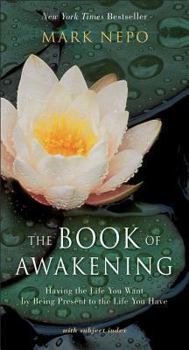 Earlier that year (2016), Susan said she had a “real epiphany.” She set herself a task of writing a poem a day first thing in the morning. She was inspired by a daily reading from Mark Nepo’s The Book of Awakening. Susan chose one word or phrase in the teaching, and wrote whatever was triggered by that word or words. She gave herself permission to write what she wanted to “even if it verges on the sentimental or self-indulgent, whatever. The astonishing thing is, I’ve had a whole month without being depressed. This is a rare occurrence for me. What’s even more astonishing is that I should be so surprised. I’ve known, since I was fourteen, that poetry keeps me ‘sane.’ Why do I forget, time after time, what it is I need to do?”
It may be that some of those morning poems made their way into a published book of poetry. If not, they may have led the way. Most important, was the permission Susan gave herself to write whatever came up on a particular morning and to enjoy the process. Keeping her “sane” would have been the best gift of all.
Silence
I’m thinking of Mary Oliver’s poem “Praying” which I’ve sometimes read at the beginning of a writing circle to take the pressure off: In the writing circles, I like us to think about the process rather than the product or outcome.
. . . .
pay attention, then patch
a few words together and don’t try
to make them elaborate, this isn’t
a contest but the doorway
into thanks, and a silence in which
another voice may speak.
The other voice could be God, in whatever form that word represents for you, or the voice could be yours: the one that doesn’t often have a chance to be heard until you enter silence on your own.
As Christine Valters Paintner has said: “Process means following the flow of what is unfolding in the moment. It means being open to a journey of discovery as we create instead of thinking we know where we are heading. It means getting out of our own way.”
Christine, who is a poet, part-time hermit, and a mystic with a website called Abbey of the Arts, says “It is a lot like prayer.”
Insights
While you may not be working on a project, you can write about your insights. I do that all the time in a journal that contains ordinary happenings, dreams, plans, and ideas.
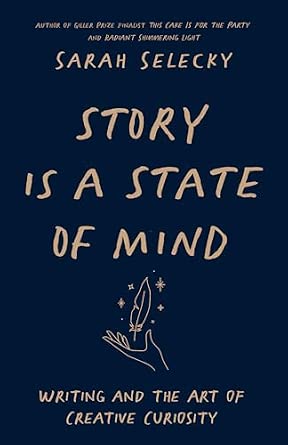 Sarah Selecky, in her book Story is a State of Mind: Writing and the Art of Creative Curiosity, writes about “tracking progress” which, in one form, on some days, could be tracking your insights. It may be you have gained insight on a walk, while watching a movie, or ordering something at your local café. Reading books has offered me the most insight. I do a lot of post-it flagging in books as well as pencil marks, if I own the book, and I always make copious notes.
Inspiration
Some writers with projects on the go keep a separate record of their questions, insights, and problems to solve. I’ve been making notes about a project I’m calling “The Risks We Take for Love” which has me exploring emotional risks as well as those we take with our writing.
I went back to an essay by Arleen Paré, “To Carry My Family in My Imperfect Head” in a book called A Family by Any Other Name: Exploring Queer Relationships edited by Bruce Gillespie. I was inspired to write some of my story by reading Arleen’s story and began to write a passage in the third person. These passages in my “process journal” may not make their way into THE BOOK but they are very helpful for remembering what happened, figuring things out, and honouring the process.
A Letter to Yourself
A “process journal” can be about one’s writing life such as plans and ideas for projects, drafts of poems, disappointments, accomplishments, fun recollections of getting together with other writers for a workshop or to talk about their writing lives. The process reminds me of the “checking in” we do at the beginning of a writing circle.
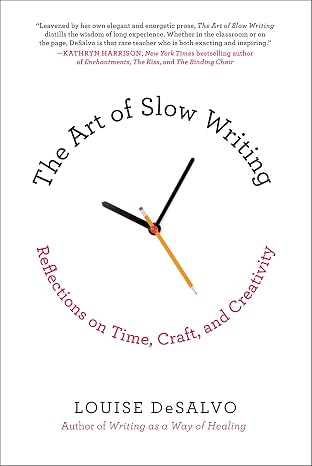 The late Louise DeSalvo says in her book The Art of Slow Writing: Reflections on Time, Craft, and Creativity: “One of the most important items in my writer’s toolbox is my process journal.” She had first learned about keeping one when she heard about Sue Grafton, author of the Kinsey Milhone mysteries, saying at a talk she gave that she kept a separate journal for each novel.
Each of Sue’s journals was about four times longer than the novel itself. Before she began work, Sue would write an entry to record her feelings, especially if feeling anxious, “a brief account of daily events, helpful dreams, ideas about the direction her work might take.”
Louise describes Sue’s process: [Grafton] describes what’s troublesome in a scene, a puzzle she can’t resolve, lines she’s imagined but doesn’t know how to use, snippets of dialogue. Grafton maintains that every solution to her work’s challenges occurs, not when she’s composing, but in her writer’s journal. There, she steps back and reflects upon her work; there, she articulates problems and solves them.”
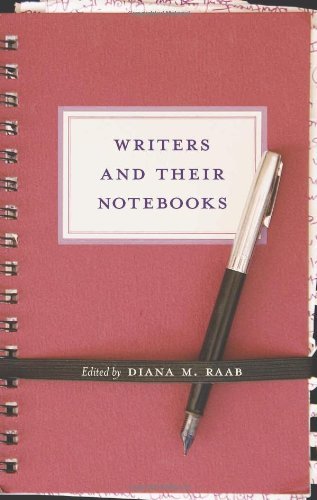
Diana Raab includes an essay by Sue Grafton (1940-2017) in Writers and Their Notebooks. Sue started keeping a “working journal” with her book “A” Is for Alibi and began to refine her method with “B” Is for Burglar. From then on she kept a daily log of work in progress “like a letter to myself, detailing every idea that occurs to me as I proceed.”
Louise DeSalvo also kept a process journal to plan a project as well as to list books she wanted to read, subjects she wanted to write about, to capture insights about her work in progress, to discuss her relationship to her work (what’s working and what’s not), to sketch scenes, to think about the work’s structure, and to puzzle through challenges and possible solutions.
Reflective Witnessing
As Louise DeSalvo wrote: “Our process journals are where we engage in the nonjudgmental, reflective witnessing of our work. Here, we work at defining ourselves as active, engaged, responsible, patient writers.”
Virginia Woolf kept diaries, which were published, describing the novels she was working on in the midst of daily life. John Steinbeck wrote letters to his editor about his novel-in-progress and those letters were published in book form.
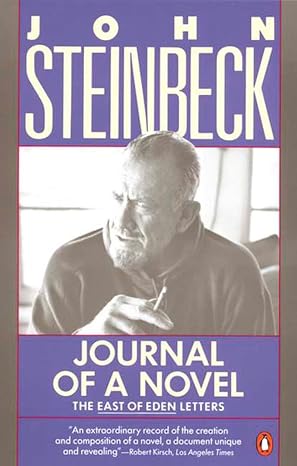 Journal of a Novel: The East of Eden letters, first published in 1969, contains letters John Steinbeck wrote to Pascal Covici, his friend and editor at The Viking Press. The letters were a way for Steinbeck to warm up to his day’s writing. He would write the letters on the left-hand page of a notebook with the facing pages filled with the text of East of Eden.
A warming up and a being with could describe the process journal. There may be no “project” to get on with. Your writing may be all about you and your life in process. Sometimes the journal could be in the form of a letter to a friend, whether sent or unsent. Or, how about a blog like this one? It can be reassuring to know there’s someone else sharing in some reflective witnessing.