Open to the irritation, grit forms a pearl it’s been said. Fish for mermaids, dive for pearls . . creativity@maryannmoore.ca
The Family of Things

The Family of Things

Susannah M. Smith’s novel, The Alchemy of Paradise, begins with an epigraph by German philosopher Friedrich Nietzsche:

What have you truly loved thus far? What has ever uplifted your soul, what has dominated and delighted it at the same time? Assemble these revered objects in a row before you and perhaps they will reveal a law by their nature and their order: the fundamental law of your very self. Compare these objects, see how they complement, enlarge, outdo, transfigure one another; how they form a ladder on whose steps you have been climbing up to yourself so far . . . 

In the prologue to the book, Smith’s narrator, a curator, describes herself as writing a collection of “dream stories” that “slowly became an advent calendar in the shape of a book – a glimpse inside each enclosure revealed a world evoked through the act of writing.”

Smith’s fictional curator lives in contemporary England and wrote The Fairy Tale Museum, which is the title of Smith’s earlier book. (Both books are from Invisible Publishing; Smith lives in Vancouver.)

The Fairy Tale Museum begins with “Instructions for Collectors.” Among the seven instructions is:

Always listen to and follow the thread of what attracts you, what ignites your curiosity. For example, the enchantment of drawers, the nesting of artifacts inside boxes, the joy of the secret wardrobe, the home inside the home inside the home – such delicious pleasures. Your yes is your guiding light.

And this one:

Your collection tells a story. In this collection, you can be anyone you want to be.

In my last blog, I referred to Orhan Pamuk, author of The Museum of Innocence, a novel. Pamuk collected items by looking in secondhand shops and flea markets as well as “the homes of acquaintances who liked to hoard things” for his fictitious family. His collected objects led to the imagining of “situations, moments, and scenes suited to these objects . . . “ (from The Naive and the Sentimental Novelist by Orhan Pamuk.) Those collected objects are housed in The Museum of Innocence, Istanbul.

What a fascinating approach to writing fiction. If you have a character already, take them out for a walk to look for treasures. Some lost or discarded objects may be sitting by the roadside or on the sidewalk. Some years ago, I saw a bowl, tarot cards, a new shoe, an old toaster on sidewalks and garden walls while staying in Victoria, B.C.

Gathering items that belonged to your family or thinking about them, will help you write about the people who are the real life characters of your poetry or prose pieces.

What objects could become your memory prompts? “Every collection is a theater of memories, a dramatization and a mise-en-scene of personal and collective pasts, of a remembered childhood and of remembrance after death,” says Philipp Blom, author of To Have and to Hold: An Intimate History of Collectors and Collecting as quoted in The Memory Palace, a memoir by Mira Bartok.

Some museums would have started with personal collections of ceramics, shoes, textiles for instance. In Zagreb, Croatia, there’s a museum of lost love with a couple’s collection of their possessions.Leslie Jamison’s essay, “Museum of Broken Hearts,” describes The Museum of Broken Relationships created by Olinka Vistica and Drazen Grubisic who ended their relationship in 2003. They found it difficult to divide their possessions and over a decade later found a home for their permanent exhibition which began as an installation at an art festival.

Jamison was inspired to write descriptions from her own life such as: “Exhibit 6: Paisley Shirt, San Francisco, California. It was sometime in 1967. We bought our paisley shirts from an outdoor rack in Haight-Ashbury. This was in the heady days of our relationship . . . “ (From Make It Scream Make It Burn, essays by Leslie Jamison.)

Poet and memoirist Carolyn Forché didn’t open a museum for visitors but when organizing and sorting through things while at home during Covid, she thought about her “museum of life” as described in her article in The New Yorker.

Here’s an excerpt from her poem “Museum of Stones”:

These are your stones, assembled in matchbox and tin,
collected from roadside, culvert, and viaduct,
battlefield, threshing floor, basilica, abattoir –
stones, loosened by tanks in the streets
from a city whose earliest map was drawn in ink on linen,
schoolyard stones in the hand of a corpse,
pebble from Apollinaire’s oui,
stone of the mind within us
carried from one silence to another . . .

Carolyn Forché, from “Museum of Stones”

One recollection leads me to another – Isabel Huggan’s memoir: Belonging: Home Away from Home. Huggan includes some fiction in her memoir such as “Starting with the Chair” in which the narrator describes objects she carries from place to place as “talismans against my own oblivion.” The writer, Huggan, is very attached to her basket of pretty stones, the bowl of seashells, and the box of letters she takes with her to each new place. She describes them as “silent stories of who you are.”

In her chapter, “Saving Stones, Huggan describes the odds and ends she has collected through the years. She finds them comforting, a way to establish place no matter where she happens to be living. “Emotional furnishings” is how she describes the things as besides their material presence, she is offered memories to prompt her writing. 

One of the instructions for collectors in The Fairy Tale Museum is: “Be ready to let everything go. The collection is meant to be shared. It starts its life with you and then you hand it over to other minds, other imaginations.”

I’m reminded of The Gift: Imagination and the Erotic Life of Property by Lewis Hyde in which he writes about works of art as gifts rather than commodities. While a work of art can exist in a market economy, it is the “gift economy” that is essential.

The instinct of capitalists going back a very long time has been to “remove property from circulation, to put it in a warehouse or museum (or, more to the point for capitalism, to lay it aside to be used for production)” Tribal peoples “understood a cardinal property of the gift: whatever we have been given is supposed to be given away again, not kept.” When passing along a gift, it’s best if it is given to a third party. “The only essential is this: the gift must always move.”

Susannah M. Smith’s narrator in The Alchemy of Paradise is part of a “family of collectors” and has “loved assembling objects, artworks, and ideas together to draw attention to them.” She asks many questions such as these “worth considering” in the chapter “The Purpose of Art.”

What if life is the Grand Tour?
What if your life in particular is a curiosity cabinet,
and it is your job to collect all the beautiful things?
What if ideas are the root of all things?
What if your ‘work’ is to seek the beautiful ideas
and collect them and revel in them and keep directing
and redirecting your mind and spirit toward
these objects of beauty?

My personal museum once had a collection of dolls from different countries, racks of coffee spoons, mermaids of all sorts, and many rubber stamps. When writing about my collection these days I thought of inherited things, long-lasting things, paper things as well as things that are gone.

Inherited Things
A quilt made of Grandma’s old housedresses,
the cutlery we use every day once belonging to Mum,
one of Dad’s soapstone carvings,
his photo albums.

Long-lasting Things
The desk with its drawers and drop-down leaf where I did homework in my younger years, hid a pack of cigarettes in one of the drawers as a teenager. Mum didn’t seem to care about me smoking. She didn’t like the lie.

There are hidden histories through objects, my friend Debbie Marshall says. I’ll be telling you about Debbie and her work in blogs to come. (Debbie’s business card describes herself as Curator, Museum of Feminist Artchives.)

“Your objects are quietly telling your story,” says Donna Watson who offers art courses through Take Two, online.

I can imagine assembling “revered objects in a row” as Nietzsche advised. Think of the story you can tell as you look at and hold each thing. Rather than a chronological order, arrange the objects in their own unique way, see how they relate to one another and “transfigure one another”.

And to end, a question from The Alchemy of Paradise:

What is the legacy you will leave
when your tour comes to a close?

While that is one of the questions, Susannah M. Smith’s character believes is worth considering, I’ll leave you with some words from Mary Oliver popular poem, “Wild Geese.”:

Whoever you are, no matter how lonely,
the world offers itself to your imagination,
calls to you like the wild geese, harsh and exciting
over and over announcing your place
in the family of things.


Three Small Things

Three Small Things

Recently, I suggested that women in an online writing circle gather three small objects to write about. It’s a tactile approach to writing and memory that brings about some fascinating and satisfying results.

With three objects, there can be a beginning, middle, and end. The objects can relate to one another as mine did about my grandmother, mother, and an ancient earth-based culture. Or there could be no apparent connection – except the objects belong to the same person – and the juxtaposition with the descriptions and memories can make the piece all the more fascinating.

Here’s what I wrote (as a first draft in the writing circle):

An amulet rests on Grandma’s handkerchief with it’s crocheted trim – The Dreaming Goddess of Malta. I haven’t been to Malta but I’m interested in earth-based spirituality where women were honoured and celebrated. The Dreaming Goddess is from the Neolithic period and her advice for today is not to take action but rather to daydream, be still, imagine. Imagine a healing place for women. Imagine.

Grandma always had some crocheting on the go if she wasn’t sitting at the quilting frame with other women in the farming community or reading her bible. Pillowcases got crocheted edges and so did handkerchiefs. It’s funny about that word – a hand kerchief. From the German perhaps. Grandma’s mother was from Germany Her father from Ireland. Her children all born in Canada. [Actually, from the Old French I found out later.]

My mother lived on the 30th floor of a 50-storey building. A restaurant close by was a favourite of hers as they served an Asian specialty called Rainbow in a Crystal Fold. A colourful, finely diced mix of vegetables and meats (the “rainbow) was spooned into fresh, crispy lettuce leaves (the crystal fold). The name was rather magical and the dish was delicious. That’s what we had for dinner for my 40th birthday when Mum gave me a ring with a ruby (my July birthstone) surrounded by diamonds. I’ve been wearing it a long time – in fact, needed to get the gold reinforced as it had worn thin.

I was interested to read in Sue Monk Kidd’s book, Writing Creativity and Soul, that she keeps a little box or some sort of container on her desk that holds an assortment of small symbolic objects related to the story she’s writing. She collected objects in a small mother-of-pearl box in the shape of a heart when she was writing The Dance of the Dissident Daughter. The box of symbols helped when her fingers would pause over the keys “and I would think, I can’t write that, and then glancing at the little box, I would write it anyway.”

“When an object is imbued with strong, personal meaning, it functions. In this case, the items in my Dissident Daughter box conjured up the presence and power of the experiences I was writing about. They became meaningful, impactful, and active all over again . . . “

Sue goes on to say: “Little boxes hold the potency, feeling, and distilled meaning of my work. They elicit a sense of connection to the material that helps sustain me for the long hall.”

Orhan Pamuk created a whole museum of objects related to his own youth, growing up in Istanbul, and the fictional characters in his novel The Museum of Innocence. His book, The Innocence of Objects, takes readers on a tour of the museum, The Museum of Innocence, Istanbul, which features everyday objects: “the ephemera, bric-a-brac, and clutter that adheres to every life.” The objects are “intimately tied: to The Museum of Innocence, Pamuk’s novel of lost love “which lends its narrative structure to their arrangement in the museum.”

If you can’t make it to Istanbul, I highly recommend the book about the collection!

All of this is part of the musing I’ve been doing about a tactile approach to storytelling and it goes back to cutting out images of models and household objects and furnishings from an Eaton’s catalogue. My friend Angie did that too and we also played with paper dolls to imagine and create scenarios and ideal family stories.

Using our imaginations, that’s what key to our enjoyment as well as keeping our cognitive abilities alive.

Beth Robinson in a book written by Merilyn Simonds called Walking with Beth: Conversations with My 100-Year-Old Friend says: “We all need solitary time; we all need to take care of ourselves physically and emotionally. And we all need a passion that is our own. How can we navigate a journey that pushes and pulls at us as hard as life does, unless we can imagine.”

I was interested to read that Beth Robinson constructs collages on her dining room table and will move one to a little table by her  armchair “where it stays until a new idea, another urge, moves her. Then she sets the collage on the floor, photographs it, and dismantles it, returning the materials to her dining table to become something new.”

Going back further in time (than the paper dolls in my own history), there were the flannel boards of Sunday school in which biblical characters, backed in flannel, were placed on the board, and moved around by the teacher to tell a story. A tactile approach to storytelling for sure.

When I say tactile I mean our hands as well as our minds are involved.

Apparently, it was the use of the hands that developed the brain. The copy of the book, The Hand by Frank R. Wilson first published in 1998, was purchased at Britnell’s Bookshop in Toronto. I don’t know if that was the year I bought the book but I haven’t lived in Toronto since 1999. That lets me know I’ve had the book a long time and my interest in the use of our hands as puppeteers, jugglers, musicians, writers, artists and creators of all sorts has gone on for decades.

Frank R. Wilson, a neurologist, writes: “Early this morning, even before you were out of bed, your hands and arms came to life, goading your weak and helpless body into the new day.” There’s more use of our hands to get the day moving with “objects to be opened or closed, lifted or pushed, twisted or turned, pulled, twiddled, or tied, and some sort of breakfast to be peeled or unwrapped, toasted, brewed, boiled, or fried . . . Whatever your own particular early-morning routine happens to be, it is nothing short of a virtuoso display of highly choreographed manual skill.”

One of the researchers Wilson quotes is Sherwood Washburn, an anthropologist, who “quite specifically insisted that the modern human brain came into being after the hominid hand became ‘handier’ with tools, maintaining that the brain was the last organ to evolve. It is a daring idea, one which requires us to look very closely at the evolutionary background of this hand, and the changes that brought it its present anatomic configuration and functional capabilities.”

The use of our hands has shaped our development and I can’t help but think that the use of our hands aids our imaginations, the stories we tell, as well as helps us through the practical and magical of every day.

“What we do with our hands has immediate effect on our emotions and sense of self, and evokes deep aspirations and ancestral motifs,” Thomas Moore says in “The Presence of the Hand” in his book The Re-Enchantment of Everyday Life. He was talking about creating things with our hands and yet I think as I arrange some items on the corner of my desk, I’m telling a story of what’s beautiful to me, what’s important, and what prompts my memory as well as my imagination.

’ll be writing more about a tactile approach to storytelling, whether memoir, poetry, or fiction. Stay tuned!


Writing as Devotion and Delight

Writing as Devotion and Delight

The word “discipline” is often mentioned when it comes to describing a writing practice. I prefer the word “devotion.”

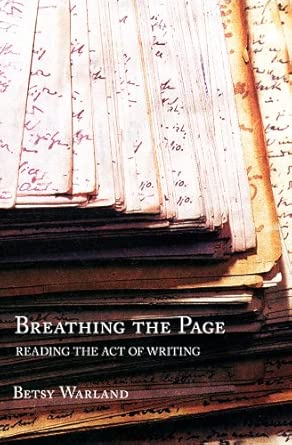
“Our methodology is not as important as our devotion,” Betsy Warland says in Breathing the Page: Reading the Act of Writing.

My writing practice, to which I am devoted, includes reading, attending workshops and retreats, meeting with other writers, writing, and imagining in all sorts of different forms.

Laraine Herring who wrote On Being Stuck: Tapping into the Creative Power of Writer’s Block, makes note of devotion as well: “If you choose writing as one of your acts of devotion, prepare to be a student of its wisdom as long as you show up for its gifts. Writing will put you forward into places you can’t yet see. It will bring with it the challenges you need to become more fully alive and awake. It will bring with it the obstacles you need to grow.”

Recently, while on a silent retreat at home, I realized that time is important for writing (there’s never enough) as well as desire. Sometimes the desire doesn’t manifest into words on the page. It can mean ideas floating in the head. Quiet time is ideal for that sort of imagining and the forming of seeds that aren’t quite ready to blossom.

That’s just right for people who are “makers” as opposed to “producers.” We makers don’t have the need to always produce a physical product. Writing is so much about the process. Is this a book or is this an ongoing process, I asked myself recently.

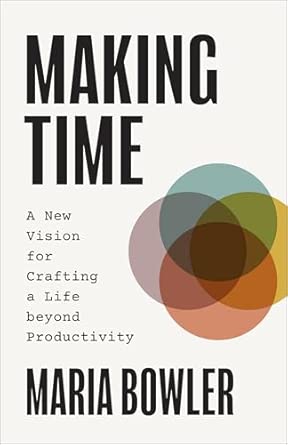
“Makers” and “producers” are described in Making Time: A New Vision for Crafting a Life Beyond Productivity by Maria Bowler. In my own mind, I think about makers in terms of intentions and producers in terms of goals. An intention is something to stretch towards, enjoying the process along the way, without an end product necessarily in mind. A goal means the future is the focus so that your current practice is all about the future rather than the present.
“Ironically, by being in touch with and acting from your true intentions, you become more effective in reaching your goals than when you act from wants and insecurities.,” says Phillip Moffitt in a Dharma Wisdom article available online called “The Heart’s Intention.”

Maria Bowler has a chapter on “Making Delight.” She says: “When you allow yourself to delight in something, you are open to being charmed by it. Unexpectedly and pleasantly transformed by it.”

Rather than a product to be monetized, or task to be accomplished, delight is part of your nature says Bowler. In writing The Book of Delights, poet and essayist Ross Gay discovered that “the more you study delight, the more delight there is to study.”

Gathering with other writers is a delight, observing what is discovered. Also, using our imaginations is good medicine for our times and brings great delight. “You have the capacity to make worlds in your mind,” Maria Bowler says. I delight in the way we can re-envision the ways things were and the way we would like them to be.

It’s a delight to read a poem called “Blueberries” by my poet friend Barbara Pelman who used four lines from a poem, also called “Blueberries,” by our mutual poet friend Laura Apol for her glosa. It’s a delight to write and see what’s revealed on the page which can be surprising at times. That happens a lot in the women’s writing circles I facilitate. Maybe you’d like to join us in June for some devotion and delight?

For five mornings in June (Pacific time), I’ll be facilitating a women’s writing circle on Zoom called “Devotion & Delight: Honouring Your Writing Practice.”

“Honour” – there’s another word to describe the writing life you want to nourish. The dates for the “Devotion and Delight” circle are June 15 to 19, 2026 – five consecutive days – 10 a.m. to 11:30 a.m. Pacific time.

If you’re working on a writing project and would like to keep up the momentum with some writing companions nearby or would like to establish and maintain a writing practice, this writing circle is for you.

Here’s a link to further information: Devotion & Delight.


Staff Picks for Invertebrates

Staff Picks for Invertebrates

“Welcome to Russell Books: an indie bookstore on an island in the Pacific Ocean, where anemones dispense life advice and staff recommend books to mollusks,” reads Guernica Editions’ description of Zoe Dickinson’s debut book of poetry: Staff Picks for Invertebrates.

“Zoe’s poetry is rooted in British Columbia’s Pacific coastline with a focus on local ecology,” as her bio reads. She’s a manager at Russell Books in Victoria and from 2020 to 2023, was Artistic Director of Planet Earth Poetry Reading Series. She continues to volunteer as a board member and you can see her on Friday nights at PEP, hosted by Russell Books, making sure readers and audience members are comfortable as they gather to listen to poetry.

Zoe’s chapbooks Public Transit (Leaf Press, 2015) and intertidal: poems from the littoral zone (Raven Chapbooks, 2022), were both award winners.

In my blog review of intertidal I said: “This is a poet we can trust with her astute observations, knowledge, and a reciprocal relationship with what surrounds her.” Zoe considers the creatures she has come to know in the ecology of Vancouver Island, her “more-than-human neighbours.”

Intertidal as well as Zoe’s new book, Staff Picks, begins with “I’d like to start by acknowledging that this poem is being / written” followed by:

on the unceded territories of the lək̓ʷəŋən speaking peoples:
the Songhees and Esquimalt nations.

The poem also acknowledges that

.. . . . my life takes place
where someone else’s life could be happening
                   that where my apartment building sits,
                   someone should be gathering camas bulbs
                   but instead, not far away, she is boiling water
                   before mixing her baby’s formula.”

The term “camas bulbs” carries a lot of weight and story. The Beacon Hill area of Victoria was one of the most productive camas territories on Vancouver Island where the lək̓ʷəŋən harvested camas bulbs for food and trading. White settlers altered that traditional practice when their cattle grazed the tops of the camas plants and pigs rooted up the bulbs. Acres of camas fields were planted with other crops such as oats, wheat, and potatoes. Houses would follow and apartment buildings as Zoe notes in her poem.

As for “staff picks,” you’ve probably seen the denotation on shelves at libraries and bookstores. In Zoe’s case, the book’s title poem has suggestions for invertebrates. Among them are the hermit crab, sea urchin, acorn barnacle, and nudibranch, a sea slug known for its spectacular colours and shapes.

For the oyster, The Creative Act by Rick Ruben is recommended as

Rick understands this essential
truth about pearls  
and poetry:  
what we create will coalesce  
around the things we need to heal,  
or conceal.

The Complete Poems of Emily Dickinson, edited by Thomas H. Johnson, is suggested for the giant pacific octopus.

. . . I think you’d like
Emily – how she retreated to her den
and doled out words,
each poem’s coiled complexity
delicious as a prawn’s tail.

You can see by the book’s cover design by Rafael Chimicatti, and the poems inside, that Zoe Dickinson’s bookstore is no ordinary indie bookstore. As she writes in “what it is”:

The bookstore has roots
with mycelial networks
as complex and responsive
as neurons in the brain –

The store isn’t all magic as there are customers of the human kind that make for “fragile places” as one poem describes. “Some vandal throws a garbage can / against the store window,” and burglars break in through the loading bay, emptying locked cases of rare tomes including a signed copy of Walt Whitman’s Leaves of Grass.

And there is “the shoplifter” wearing “the same red velvet tracksuit” and the customer who hasn’t bathed in a year and a half, he says, and smiles in “how to wake up.” There are those who call with strange questions that they could Google on their own such as described in “customer service.” And there’s the kid who rubs his saliva-coated palms on the “escalator’s smooth / rubber handrail.” The title of that poem: “dumbstruck.”

The escalator in Russell’s is a significant presence and is turned off for poetry readings. Described as “the captive god,” it gets its own poem in Staff Picks: “the escalator.” While the escalator “browses our romance section” after dark, the poem’s speaker can’t help but think of being at the edge of a cliff and imagining falling off “in grisly detail.”

You can’t imagine what is contained in the used books brought in to “the book trade counter.”

Each book tells two stories:
what’s written on the page,
and what happened to the page

The unexpected items found in used books include:

wedding photos, grocery lists, fall leaves,
a blade of grass  
a strand of cooked spaghetti  
a sewing needle

and once
a newborn’s hospital record,
the baby’s footprint achingly perfect
in crisp blue ink

Wow, Zoe saved the most poignant one until the end.

We book lovers love bookstores and I love the way Zoe describes hers in “it is not your friend.”

The bookstore is not anyone’s home
but at dusk, its windows
are the same shade of yellow
as the kitchen window in the house
                  where you grew up

And to close her tribute to the bookstore:


It is not your friend
but it will introduce you to the love
                          of your life.

That “love of your life” could be a book, definitely, or could be someone browsing in the same aisle.

If it’s “chicks” you’re looking for, there are sections to avoid as advised in “where not to pick up chicks at a bookstore.” One of them is

Romance

Is a lot to live up to
don’t approach
unless you can promise
happily ever after

You’ll learn new terms in Staff Picks (like “fuzzy onchidoris” in the poem titled “nudibranch” and “tapestry of hyphae” in “lichen” and if you don’t understand them, don’t call Russell Books – unless you’re looking for a book about invertebrates or Zoe’s book of course. You could join the Field Naturalists as Zoe has or engage the help of Marine Detective Jackie Hildering.

One of Zoe’s gorgeous poems is “aubade” which is a form either welcoming or mourning the arrival of dawn. I’ll leave you with another piece of writing by Zoe, this one from Facebook, about the night sky and the bookstore she loves:

Locking up after @planetearthpoetry tonight… Russell Books glowing in the dark. I’m listening to an advance reading copy of Suzanne Simard’s new book, When the Forest Breathes, and she of course is all about the complex web of symbiotic relationships happening under the forest soil, in which different species nourish each other. Anyway Russell’s is like that, a bit. A seemingly homogeneous pile of stuff (i.e. a metric crapton of books) that is more complex the deeper you look, almost fractal in its depth of detail, and that improbably supports an amazing variety of life.


,


Twenty-Five Days

Twenty-Five Days

It’s been ten years since I had cancer which makes it time to celebrate that milestone of Ten Years Cancer Free!

Following a biopsy on my shin which revealed that the lump was spindle cell sarcoma, my GP in Nanaimo told me there would probably be some treatment and surgery. That didn’t sound too bad.

Then Sarah and I went to meet the orthopaedic sursgeon at the BC Cancer Agency in Vancouver.

Ravenous

Because the surgeon bears an impish grin
and pulls himself closer to me on a wheel-less
stool – he looks me straight in the eye
long enough to know he sees me –
and because he wears a mauve shirt with
co-ordinating tie, directs my gaze to a wall
calendar and says,
This will all be over in five months,
I accept his prescription:
five weeks of radiation,
six weeks of rest,
surgery in November.

We leave the office, walk slowly to the car.
Let’s just go home, Sarah says.

Because our home is across the Salish Sea,
we drive, silent, to the ferry. In the line-up,
Sarah goes for take-out fish and chips.
When they arrive, I eat them. Ravenous.

Five weeks of radiation on my left shin sounded ominous but it all worked out. I stayed at the Cancer Society Lodge near Royal Jubilee Hospital and the BC Cancer Society in Victoria where I had the treatments. The radiation technologists were friendly and efficient. Radiation isn’t painful; I just had a red burn on my left leg. That didn’t stop me from exploring Victoria where I’d walk in a different direction every day.

Twenty-Five Days

Every day after breakfast,
not always the same time,
I sign myself out at the front desk
of the lodge where out-of-town
cancer patients stay. Walk
down the steps, turn the corner
onto Richmond –
always
on the same side so I can
pause at the house with Buddha
in the garden – then pass the bus stop
where no one makes eye contact.
Inside the clinic, after the café and
the gift shop, I head downstairs.
A man stops when I come near, says
it’s bad luck to pass on the stairs,
presses his body against the wall and,
gives me a nod. I know where I’m
going. Through the waiting area,
peach and lime-covered chairs,
down the hall of donated paintings.
I put my white card in the tray
that says Fir. Sometimes I don’t
wait at all. When they’re ready
for me, I take off my shoes and
socks, roll up my left pant leg.
Hannah says, “Good morning
sunshine.” I shimmy into position
on the table. “Two to the right”
an RT says as they line up the
machine, place a pink bolus
on my shin. Hannah covers me
with a warm blanket. I don’t
remember the name
of the 6-million-dollar machine
even though I’ve stared up at it
twenty-five times. I close my eyes,
see my dead mum and dad doing what
they can to say everything will be all right.

My mother had died in 1995 and my father in 2014, a year before the radiation treatments. His wife Jean told me that if he had found out I had cancer, it would have killed him. Both my parents died of cancer affecting the lungs. Mine was different and didn’t end my life.
Staying at the Cancer Society Lodge was a cozy home base during the week when I was in Victoria. On the weekends, I’d return home to Nanaimo via Wheels for Wellness, vans driven by volunteers.


This next poem begins with an epigraph:

My own life hovers, newly emerged,
alert as to who I will become upon leaving this place.

                                                                                        Melissa Pritchard

At the Lodge

At the table in the lodge dining room, Brenda says
she wants to have a party on Thursday as we all
leave Friday for a weekend home. She’s found
some old sheet music by the piano, hopes to get
the karaoke machine working.

Brenda is close to the end of treatment. Her meal
choices: vegetables with béchamel sauce, sometimes
a smoothie, and on the way home in the Wheels for
Wellness van, her favourite: a Tim Horton’s frappuccino.

I’m new to the place and the diagnosis, curious
about Brenda’s need to celebrate and about the way
the women choose to talk about their prognosis.

Every hair of her wig in place, every rhinestone
perfect on her jewelry, Fay tells us what’s she’s afraid of.
Hilary says: Let’s not go there.

There’s someone new in the corner – a man
in a freshly ironed shirt, tray full of dinner,
in front of him. His neck gags when he lifts the fork.
Sometimes, he leaves the table to return and try again,
head bowed.

One of us goes for the nurse who crouches down
beside the man’s chair, removes the tray, says, it’s all right
as the man murmurs: I didn’t want to waste the food.

Is it better to toss the wigs and rhinestones?
Who will continue to be upon leaving this place?

I wonder how the other patients are doing now? Are they continuing to be, that is, to live?

Dr. Paul Clarkson, who told me “this will all be over in five months” wasn’t quite accurate. There was still surgery scheduled for December. (The radiation treatments took place in August – September.) Then the surgery was cancelled when I was all prepped at Vancouver General, the doctors having signed my left leg including the plastic surgeon who would be doing the skin graft.

When I went back in January 2016, I had the same orthopaedic surgeon as he’s a specialist when it comes to spindle cell sarcoma; the anesthesiologist and plastic surgeon had changed. The cancerous lump and margins were removed and I recovered for ten days or so at VGH. A hospital is a noisy place to try and recover but I did get the best care and visits from my son Andy which was the best gift of all.

Back at home, Sarah wore about seven hats as she became doctor, nurse, physiotherapist, occupational therapist, driver, head cook and bottle washer. Imagine taking on the challenge of changing the dressing on a skin graft, a very delicate procedure. She did it! Some of the driving involved ten trips by BC Ferry to Dr. Mark Hill at Vancouver General for check-ups on the skin graft. Those were the days of “thinking pink” as that was the result that indicated healing. 

Something we weren’t told in advance was that I couldn’t walk on my left leg for a couple of months due to the skin graft. That was indeed a challenge but I did get walking again with the help of a physiotherapist, graduating from crutches and wheelchair to walker and then cane.

Recently I was in Victoria in the Oak Bay area which was one of my haunts ten years ago as it’s close to the BC Cancer Agency and the Cancer Society Lodge. Driving through the neighbourhood, I saw the various coffee shops I visited and restaurants where I had lunch.

I had a desire to go and see if Hannah still worked as a radiation technician and if she was still knitting.