
One afternoon last week when the power went out, I sat in our living room looking at poems including some handed out by my late friend Richard Osler at one of his poetry retreats in 2013. “But Still We Sing” was the theme of the retreat Richard facilitated, after the words of our mutual mentor Patrick Lane.
“What violence it takes to make song. What life we must lead so we can sing,” Patrick wrote. To that Richard said: “And I would add what courage we must have as poets to risk singing our lives into song and how present we must be to our lives.”
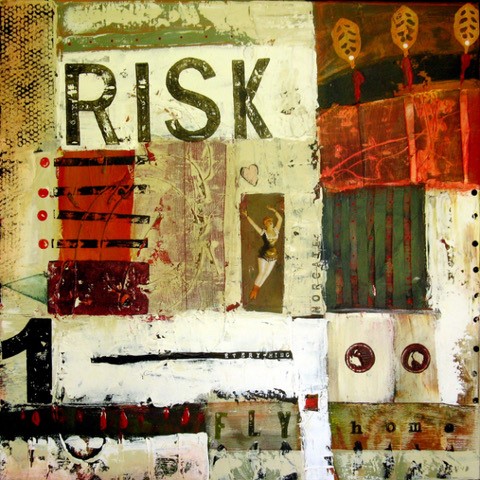
I had been thinking of writing and risk particularly since I referred to it in my last blog: “Honour Your Voice.” I quoted Nanaimo artist, performer and writer Sheila Norgate who said: “Risk must be at the centre of any creative voice if it hopes to burn hot enough to scorch the impurities of the ego.” (Thank you to Sheila for the use of her painting “Risk” to help us take a leap.)
The first risk we take as writers is facing the blank page. We become vulnerable, honest with ourselves, write our version of the family stories.
Before thinking about readers, whether family members or the general public, we tell the story for ourselves. “The point is not to find a reader, the point is the telling itself” says Anne Carson in “Could I.”
Sheila Norgate who publishes her memoirs under her own imprint, LIP (Ladies Institute Press),said in a talk she gave along with Nanaimo artist Grant Leier some years ago: “All I can say is that [answering the call] has something to do with risk, and how at some point for me, the risk of flying without a net finally became smaller than the risk of never having flown at all.”
“Without a net” meant relying on her own earnings, sometimes with a part time job, rather than being beholden to art galleries who were concerned with what would sell.
In her notes given to me following the talk, Sheila had written: “The impulse to make art that came over me in the early 1980s, had nothing to do with money. The calling was pure, and loud, and flooded with uncontaminated devotion.”
The value of getting in touch with our own story far outweighs any financial gains we may realize.
We may take a risk in sharing our writing with loved ones. One might assume we could get some encouragement there. That’s not always the case.
Gwyneth Lewis, a Welsh writer and inaugural National Poet of Wales, said in her memoir Nightshade Mother: A Disentangling, that her mother called her a fool for putting time into a writing commission that didn’t pay off. Gwyneth said: “I was speechless. I could have said: Because that’s what it takes for me to be a writer. I risk everything every time, otherwise, there’s no life in the work. And you’ve just wiped out what I am. Instead, I picked up my things and left, calling myself a fool for letting my guard down.”
In sharing our writing beyond the people we know, we open ourselves to further judgement, criticism, rejection, being ignored altogether. Family members may get rankled. We don’t risk the same outcomes as others in the world who have been imprisoned or exiled from the countries where they published their work.
Elissa Altman wrote a beautiful chapter about her father in her memoir Poor Man’s Feast: A Love Story of Comfort, Desire and the Art of Simple Cooking. When her family read it, particularly her one cousin, she “sliced” Elissa out of the family. The story Elissa had shared was about her father and his sister being left by their mother for a few years when they were young. The story had been a family “secret.”
Elissa writes about that repercussion in her memoir Permission: The New Memoirist and the Courage to Create. She had considered leaving out the abandonment of her father in the paperback version of her earlier memoir to appease her cousin. “Could the narrative work without this fundamental, core truth that made my father who he was, and I who I am, or would it be transformed into a three-legged table?”
“The truth – my grandmother’s, my father’s, and mine – had to be told. The narrative could not stand without it; I left it in. “
“Did my cousin own the story of my grandmother’s leaving? Was it hers, like a fingerprint?”
“No, we all own it.”
“What must be said in spite of ourselves,” Patrick Lane wrote. Here’s his quote included In my last blog on “voice”:
“What we must come to is authority, a taking upon ourselves the rich voice that is in us and acknowledging it; to say what must be said in spite of ourselves, admit to what is both right and wrong in us and make of those choices a witness to the world. Each of us has a voice. We find it when we step past imitation and create out of our own experience, spiritual, emotional, and physical. It is there we find the authority of ourselves. At the heart of authority is integrity. What we risk most is our own truth found in ‘the foul rag and bone shop of the heart,’ as Yeats so eloquently wrote. It is of the world.” (From “Meditation – Authority,” a handout by Patrick Lane)
When Patrick’s wife Lorna Crozier gave a talk called “Writing and Risk” when she was the Ralph Gustafson Distinguished Poet at Vancouver Island University she spoke of an experience she had following her contribution of an essay to one of the Dropped Threads anthologies that Carol Shields edited. Lorna began her essay about her father’s addiction with: “My father was a drunk.” It was the insistence on silence that had severely damaged her she said.
“You’ve done a terrible thing,” Lorna’s mother said to her on the phone one day when Lorna had returned from some travel. A lay minister at the church Lorna’s mother had attended for several decades, spoke about the essay that Lorna had written. Some people blamed the minster for sharing the story but Lorna said: “It wasn’t the minister’s fault, it was mine.”
Lorna said in an interview around the time of that talk: “I think if you don’t show the flaws, if you don’t look into the shadows and dig into the darkness, then you’re writing stuff that is in danger of being Hallmark greeting cards and being shallow instead of trying to go for what poetry tries to get at and that’s the great unknown and the great disturbing and all of those things that poetry wrestles with.”
As she ages, Lorna asks herself the question, do I have something new to bring to the table? I must find ways to disrupt my complacency.
These are the risks I take, she said at the end of her talk: terror and astonishment. My fierce and only life.
In an interview in The Globe and Mail about her book of poems, Lost and Found Department, Japanese-Canadian writer Joy Kogawa said: “It feels safer to run headlong into the fire of difficult truths and to get to the safe place of ashes when the fire is spent. If we acknowledge our wrongs, if we publicly embrace what we would rather people didn’t know, I think we make the world safer.” (The Globe and Mail, December 30, 2023)
“What would happen if one woman told the truth about her life? The world would split open,” the late poet and activist Muriel Rukeyser said.
Jeanette Winterson who wrote, Why Be Happy When You Could Be Normal?, says she turns to writing as a life preserver. The title of her book is what her mother said when Jeannette fell in love with a girl. “I need words because unhappy families are conspiracies of silence. The one who breaks the silence is never forgiven. He or she has to learn to forgive him or herself.”
You may want to consider risk an ally as the late John O’Donohue has said: “Risk might be our greatest ally. To live a truly creative life, we always need to cast a critical look at where we presently are, attempting always to discern where we have become stagnant and where new beginning might be ripening.”
You may do this. I tell you, it is permitted.
Begin again the story of your life.
Jane Hirshfield, from “Da Capo”