
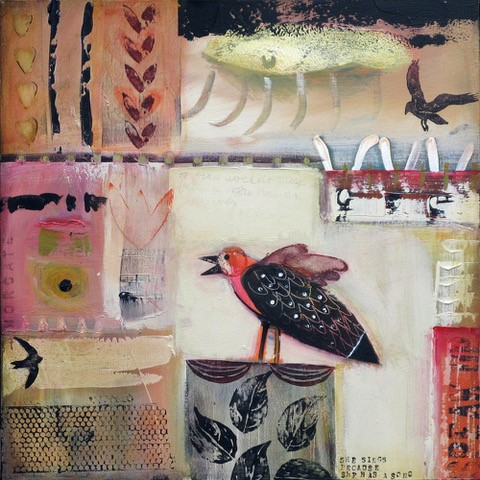
In a writing circle when I give an invitation or prompt which could be in the form of a question or a line from a poem, each person writes something different, in their own voice. Voice is who we are, who we’ve been, and who we are becoming.
For the Writing Life women’s circles I facilitate, the motto is: Nourish Yourself, Honour Your Voice, Write Your Stories. To honour your voice, you need to be in a space that feels safe to write the stories waiting to be expressed and to give free rein to your imagination. Guidelines set down with intention help us to create that space together.
The wonderful image you see is a painting by Sheila Norgate, a visual artist, writer, and performer based in Nanaimo, with the title of “She sings because she has a song.” I love the title and it’s perfect for musing about voice.
I watched a video by Sheila on her website, in which she focused on voice when she talked about her forty years as a self-taught artist. She didn’t continue taking art courses due to some health issues in 1985 (she got all A’s in the first term!) and realized later that her voice could be drowned out by other people’s expectations.
Sheila was represented by various art galleries through the years and finally separated the world of commerce from the “house of my creative voice.” There’s less tolerance for risk in art making when financial stability is a goal.
“Risk must be at the centre of any creative voice if it hopes to burn hot enough to scorch the impurities of the ego” Sheila says.
Taking risks with one’s creativity and developing one’s voice isn’t always possible when having it silenced by educators or the marketplace. People have been known to go with what they know sells in an effort to gain some financial stability.
Whatever the challenges, our voice is unique to each of us. As Mary Pipher said in her book Writing to Change the World: “You have something to say that no one else can say. Your history, your unique sensibilities, your sense of place, and your language bestow upon you a singular authority.”
“Who but you can describe the hollyhocks in your grandmother’s backyard, or the creek outside of town that you fished as a child, or the way it felt to be the only person of color at your college? Who but you can tell about the faces at the soup kitchen, or in the burn unit?”
My poetry mentor, the late Patrick Lane, also made note of your own authority in a piece he wrote called “Meditation – Authority” which he gave out at one of his many poetry retreats.
Patrick said a beginning writer doesn’t trust her own voice. That’s “because it resembles no one else’s . . . all a writer’s doubts, all their low self-esteem, rises up when presented with our own utterance. The solution is often to imitate others who we think are more accomplished. And indeed, imitation can teach us much, but in the end we are left with our own heart and soul, our own unique and remarkable selves. It is from there the poem will arise in all its tawdry elegance, dressed as it is in wondrous rags.”
“What we must come to is authority,” Patrick wrote, “a taking upon ourselves the rich voice that is in us and acknowledging it; to say what must be said in spite of ourselves, admit to what is both right and wrong in us and make of those choices a witness to the world. Each of us has a voice. We find it when we step past imitation and create out of our own experience, spiritual, emotional, and physical. It is there we find the authority of our selves. At the heart of authority is integrity. What we risk most is our own truth found in ‘the foul rag and bone shop of the heart,’ as Yeats so eloquently wrote. It is of the world.”
Patrick Lane was a poet, novelist and memoirist. He wrote: “All poems are a musical score for the voice. The poem rises to deliberate song. It is not casual whistling, not humming tunelessly in a state of distraction. Each sound, each musical phrase, creates an integrity of mood and so creates the feeling we are trying to elicit. Authority is probity, a strict honesty. Authority is a private voice we overhear inside ourselves. Where authority is found we find knowledge and a truth (not the truth). “
Mary Pipher wrote: “This offering of the library of self can be called voice. Voice is everything we are, all that we have observed, the emotional chords that are uniquely ours – all our flaws and all of our strengths, expressed in the words that best reflect us. Voice is like a snowflake – complicated, beautiful, and individual. It is essence of self, distilled and offered in service to the world.”
As Patrick said, your voice resembles no one else’s. Here’s what the late Annie Dillard wrote in The Writing Life: “Why do you never find anything written about that idiosyncratic thought you advert to, about your fascination with something no one else understands? Because it is up to you. There is something you find interesting, for a reason hard to explain. It is hard to explain because you have never read it on any page; there you begin. You were made and set here to give voice to this, your own astonishment. ‘The most demanding part of living a lifetime as an artist is the strict discipline of forcing oneself to work steadfastly along the nerve of one’s own most intimate sensitivity.’ Anne Truitt, the sculptor, said this. Thoreau said it another way: know your own bone. ‘Pursue, keep up with, circle round and round your life . . . . Know your own bone: gnaw at it, bury it, unearth it, and gnaw at it still.’ “
As one of my poet friends, Martha Royea, said: “We have voices and need to fall in love with them.”
Here are some words to leave you with on the subject of voice. They’re from a Tewa prayer:
Within and around the earth, within and around
the hills, within and around the mountains,
your authority returns to you.