
Remember the vision boards we used to make? People, I expect, still create vision boards to dream about an imagined future. Often those images are cut out of magazines and are specific so as to draw what one desires into their life.
I remember doing vision boards that included places such as retreat centres where I thought I’d like to offer writing circles. I realized at some point that actually, I’d like to stay closer to home.
For several years, I haven’t been going for specifics in creating a collage; I go for what has energy for me. I did that when Sarah and I were looking for a new place to live four years ago and it worked out very well. The images I was drawn to included trees, flowers, comfortable chairs for two, and not intentionally, a small bear in the corner. All of those aspects are part of the home we now live in, including the bear although we didn’t see him this spring!
I’ve done collages for writing projects too to see what the collage has to tell me – again, choosing images that I’m drawn to.
In her book Writing Creativity and Soul, Sue Monk Kidd says she has created a collage to illuminate a fictional story. “Of course, it wasn’t just the pictures that were reverberating for me. The archetypes, memories, and emotions behind them hooked my attention and conspired with the storyteller inside who was gathering material.”
My interest in archetypes began a long time ago probably while reading portions of the work of Carl Jung. I’m fascinated by The Wild Unknown Archetypes, a card deck by Kimi Krans, and The Archeo, Personal Archetype Cards by Nick Bantock.
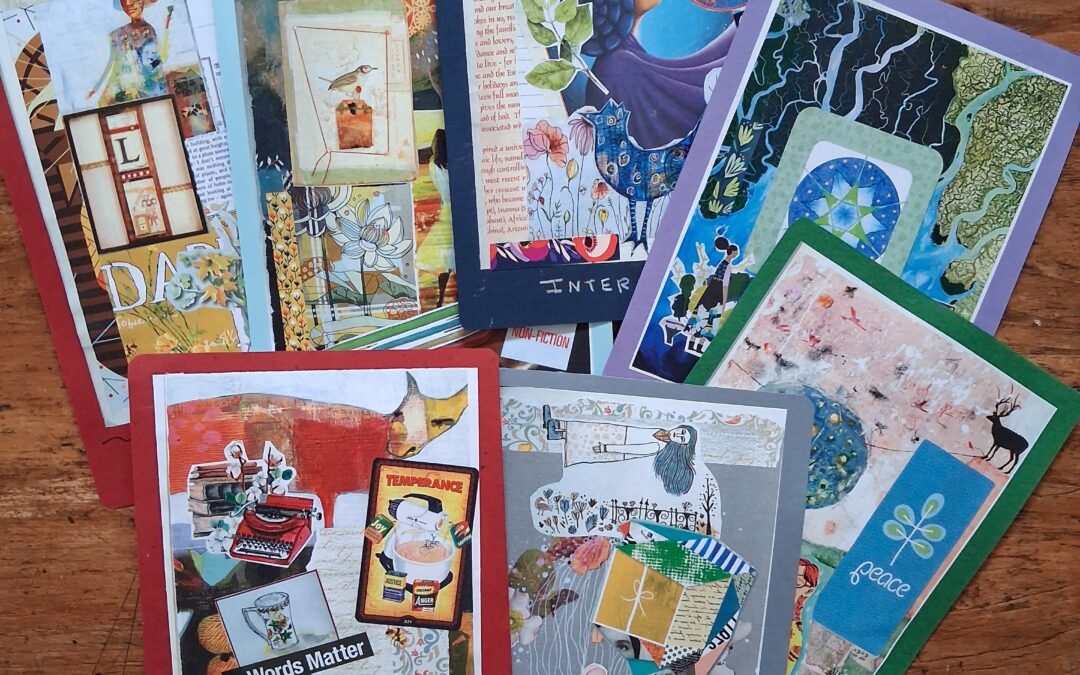
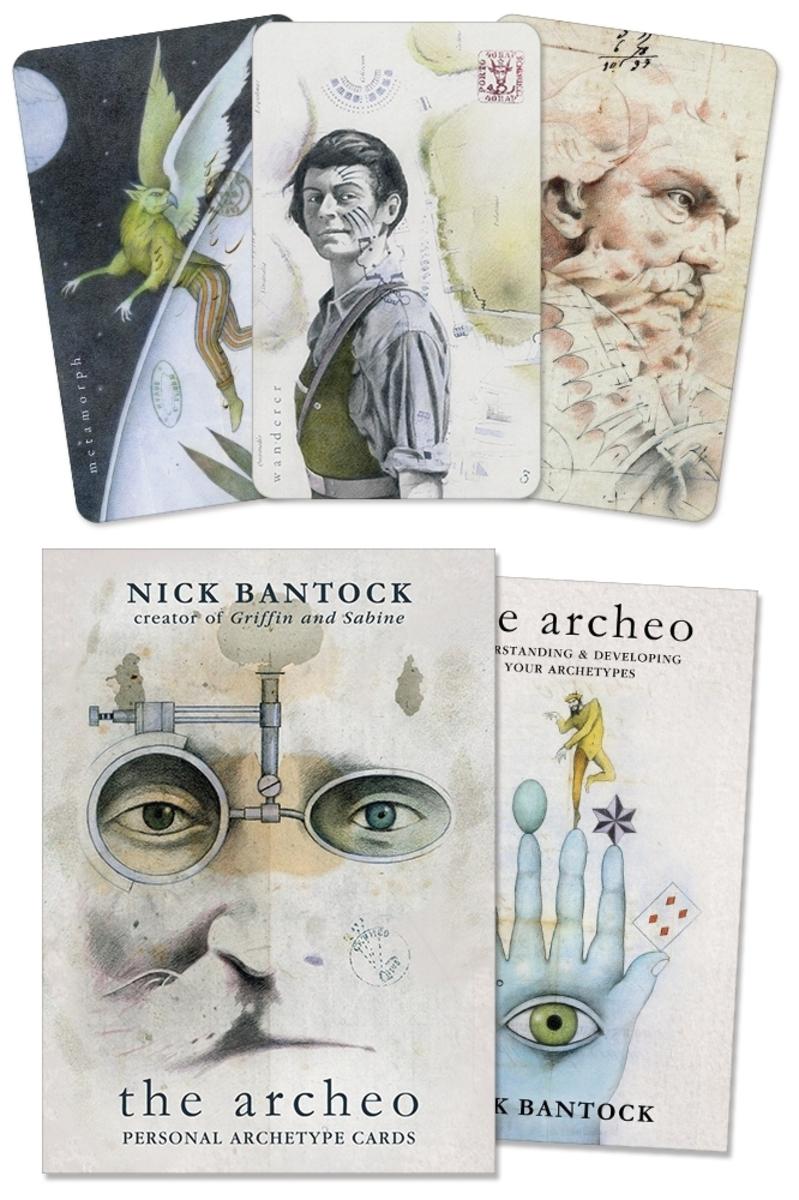 It was Nick Bantock’s deck and book that got me going on my own personal archetype cards. Some of the collages I did for the fun of it, or with an intention such as “My Writing Life,” became personal archetype cards. The collages came first and then the archetype I assigned to them. Among the cards are: Writer, Napper, Daydreamer, Note Taker, Interbeing, Memoirist, Collager. There are many more to come!
I reduced the collages in order to put them on cardstock to create the cards. I wrote about each listing the symbols and then a short description. You’ll see them in the photo above.
On the back, Napper says: Symbols: a woman with blue hair, suspended, a gift with ribbon, flowers, a tea cup, a feather in an inkwell, very thick books, words of Frank Ostaseski from “The Art of Caring.”
The description reads: My bedroom is like being at a cottage, a fresh spring breeze through the window from the forest behind. I read a bit before I doze and then dream as if suspended in the middle of my day. A feather lands on the outside sill. I bring it in to an ink bottle, scratch some words in the very thick books of my life. Afterwards, a cup of tea – this whole life practice, a gift of multi-layers.
One of my personal archetype cards is Collager. My description says: A collage offers hints of things, curiosity: What’s hidden? What’s underneath? There are blanks to be filled, or not. Sentences without beginnings or ends. From the images I chose, what do they have to tell me? There’s more to the story than meets the eye.
Exploring your personal archetypes is a wonderful way to celebrate and honour all aspects of yourself.
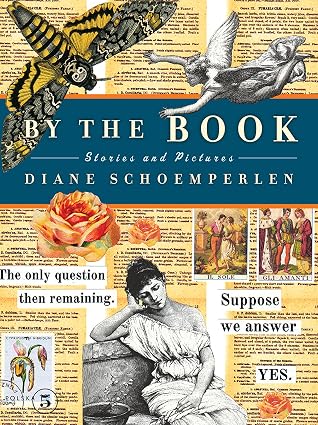 I find it intriguing and inspiring to see what others have done with collage. Diane Schoemperlen, a writer who lives in Kingston, Ontario, is a great collager. In her introduction to By the Book: Stories and Pictures (Biblioasis, 2014), Diane says: “Collage is the most accommodating and unpredictable art form, an often playful arrangement of visual fragments that produces a final collective image that is always much more than the sum of its parts.”
Diane’s book is made up of seven stories “based in various ways on old texts from the late nineteenth and early twentieth centuries. In the tradition of the objet trouvé, especially found poetry, these stories take the form of a found narrative: an imagined, expanded, and embroidered rearrangement of the original material.”
The collages were constructed the traditional way, cutting and pasting with “real paper, real scissors, and real glue. This tactile experience was a vital part of the creative process that could not have been achieved by manipulating the images and text digitally.”
It’s that “tactile experience” that is most intriguing to me.
By the Book is a fascinating construction “or a deconstruction or a reconstruction (or maybe all three)” as Diane says. She refers to Octavio Paz who wrote in one of his volumes of essays (Alternating Current), about “the contrapuntal unity” of “fragments connecting, reflecting, and deflecting in variable relation to each other. The creative possibilities offered by this intersection of the written word and the visual images are unlimited, the juxtaposition of these two elements producing frequently starting exploration of connection and disconnection, resonance and dissonance, collision and collaboration.”
Such collisions and collaborations are fun with cut-out words from magazines to create collage poems. Also, using the lines of other poets found in literary journals or books of poetry can create a collaborative poem called a cento.
Eve Joseph in the introduction to her book of poetry called Dismantling (Anvil Press, 2026), half of which is made up of centos, says of the form that it “collapses boundaries between the living and the dead and allows for unexpected alliances and conversations.”
Eve wrote her centos in the form of prose poetry which she sees as a “collision.” “I am drawn to the energy of this impact and to the possibility of creating something new out of two established genres.” (Those genres are prose and poetry.)
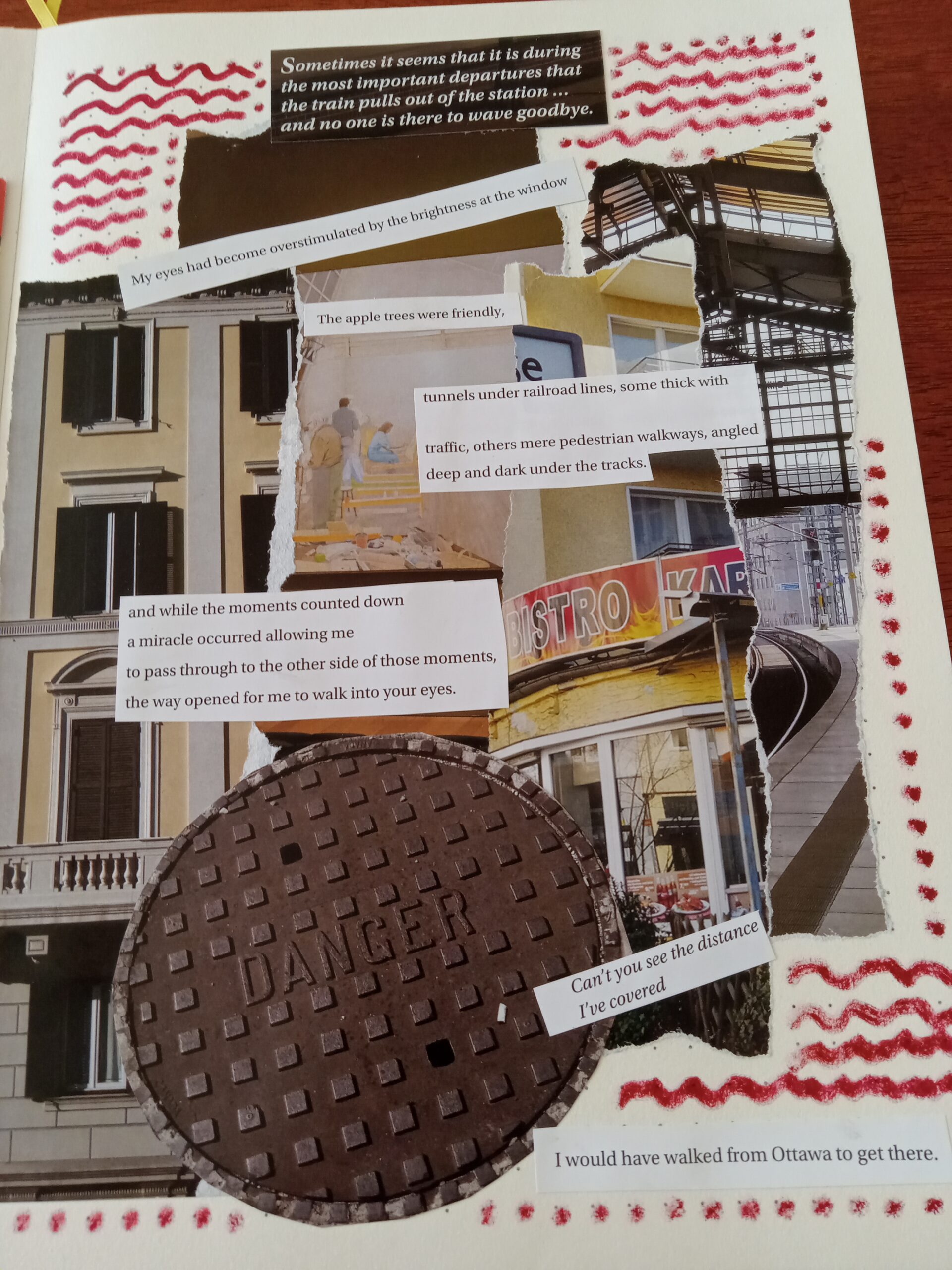
I don’t know if Eve photocopied poems and then cut out lines to play with them physically. It’s something I did with an old copy of The Queen’s Quarterly which included the poetry of several poets.
The background is made up of ripped images from the journal and excerpts from the poetry of several poets are pasted on top. The cento begins with a line from “Happiness” by Ronna Bloom: “My eyes had become overstimulated by the brightness at the window.”
The lines that follow are from poets Michael McCarthy (“Sam Gosling’s Corner”); Claudia Coutu Radmore (‘ma famille francaise, Montreal, 1950s”); Russell Thornton (“A Seder”); Claudia Coutu Radmore from the same poem noted; and Tim Bowling (“Sweet Sixteen”).
There are examples of such an approach in PoetryXCollage magazine introduced to me by my friend Debbie Marshall.
Volume One of PoetryXCollage features a collage by Rosemary Rae of El Cajon, California. As her bio reads: “Not all language is contained in words. Emotions and dreams are hidden in the shape of color or in a simple composition on a page, just as silence can be found in a strip of paper or an em dash.” Often a collage sparks a poem which is what happened in Rosemary’s collage called “Moon & Swan.” It contains old photos, fabric, pencil, torn book pages and her poem.
Here’s a link to the issue I’m referring to: https://shop.kolajmagazine.com/product/poetry-x-collage-vol-1
I hope you’ll consider gathering some words and images cut out of magazines, flyers, greeting cards, old books and along with a glue stick,and scissors nearby, explore the archetypes, memories, and emotions that can result from images that then inspire the written word. A tactile approach to writing.
what a great and rich and generous exploration of collage. thanks MA
Thank you Sheila! I’m sure I’ve got more to say about collage as explorations continue.
You’ve inspired me to go back thru the stack of pages I’ve saved over the years and do something with them. Yes. A collage.