

It may be that we avoid getting back to our writing practice as we’re anxious about what will come up in the silence. Creating a ceremony as a container for your writing practice offers something predictable in the realm of creativity which can take us into the unexpected. (You can also see my previous post on “Your Own Tea House Practice.”)
In Mastering Creative Anxiety by Eric Maisel, he writes: “To create and to deal with all the anxiety that comes with creating, you must acknowledge and accept that anxiety is part of the process.” He also says: “Since anxiety accompanies both states – creating and not creating – why not choose creating?”
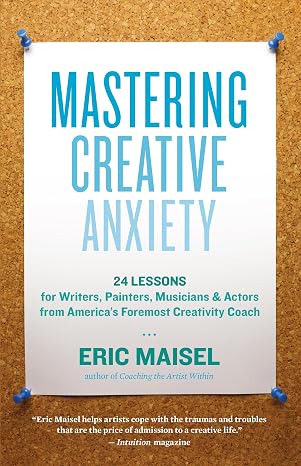 One of his “Twenty-Two Techniques for Mastering Anxiety” is Ceremonies and Rituals. He believes “creating and using a ceremony or ritual is a simple but powerful way to reduce anxiety.”
My love of ceremony relates to the rituals of earth-based practices and an acknowledgement of our ancestors cheering us on. I may burn some sage and greet my guides at my writing table. In writing circles I facilitate, we create a container following circle guidelines and a ceremony by beginning with a poem and lighting a candle.
Invite fear and anxiety in
Acknowledge and name the discomfort: the sore back, the queasy feeling in the pit of your stomach, the desire to be anywhere else but at your writing desk. The creative person lives through the tension, looks at the uncomfortable feelings, names them, records them and shares the insights with others. (That last sentence was adapted from Witness to the Fire: Creativity & the Veil of Addiction by Linda Schierse Leonard.)
Breathe
To become centred, focused, present at any time, anywhere, follow Zen Buddhist monk Thich Nhat Hanh’s suggestion for three breaths. This is something we do in the circle as well:
the first breath to let go,
the second to stay here,
and the third to surrender to what’s next.
Relax
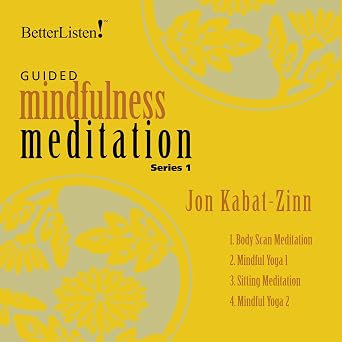 I’m a fan of the work of Jon Kabat-Zinn who developed Mindfulness-Based Stress Reduction. My favourite is the body scan for deep relaxation included on his Mindfulness Meditation CDs. Listening to his voice helps to give me permission to take time for myself away from interruptions. Without the CD, you can simply lie on the floor and drop into it, letting every part of you relax. Savassana, the corpse pose in yoga, is a beautiful way to let go. (Yes, I still have these CDs!)
Meditate
Meditation, as far as I know, is accepting how you are feeling right now. (That’s what I learned from Jon Kabat-Zinn.) The resulting feeling is one of acceptance and possibility. Meditation helps you to accept your motivation and your non-motivation. I appreciate loving-kindness meditation which is repeating something like the following metta or something you’ve made up yourself:
May I be filled with loving-kindness.
May I be well.
May I be peaceful and at ease.
May I be happy.
Here are some other phrases from Wayne Muller’s chapter, “Fear and Faith,” in Legacy of the Heart: The Spiritual Advantages of a Painful Childhood:
May I be balanced and at peace.
May I be undisturbed by the changing events of my life
and the world around me.
May I have faith in myself.
May I have faith in the strength of the spirit within me.
Affirm
“The Artist’s Creed” from Marry Your Muse: Making a Lasting Commitment to Your Creativity by Jan Phillips is very affirming. Here is one of the beliefs I particularly like:
I believe that what truly matters in the making of art
is not what the final piece looks like or sounds like,
not what it is worth or not worth,
but what newness gets added to the universe
in the process of the piece itself becoming.
Animate the Body
Take a walk, dance in your living room, drum, sing, shout. Dance to one of Gabrielle Roth’s CDs or to your favourite lively music. Let your body guide you in spontaneous movement.
Offer Your Writing
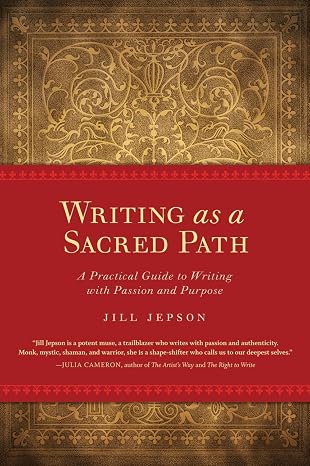 “Envisioning your story as your personal gift is an acknowledgement of the significance and beauty of the work you are doing,” says Jill Jepson who wrote Writing as a Sacred Path: A Practical Guide to Writing with Passion and Purpose.
Begin by offering your story. You could say aloud, for example: “This story is my gift to my grandmother and grandfather.”
Second, keep your gift in mind as you write.
Three, conclude by offering your story. You can “light a candle and hold the story up toward the sky or close to your heart. Infuse it with your love. If you have a home altar, you can place it there for a time. . . Whatever you can do to ritualize your offering will confirm that you are bestowing a gift that is not only priceless, but unique in all the world.”
Fear and anxiety can come in different forms: physical manifestations, avoidance, or any number of ways unique to each individual. When ceremony and a connection to something larger than ourselves become an essential part of our creative journey, I feel we are able to make it through the tension and discomfort knowing our work is healing to ourselves, our community and the earth.
 Today, like every other day, we wake up empty
and frightened.
Don’t open the door to the study and begin reading.
Take down the dulcimer.
Let the beauty we love be what we do.
There are hundreds of ways to kneel and kiss the ground.
Rumi (as rendered by Coleman Barks)
Beautiful Mary Ann. Thank you!
Lovely. Thank you!
Lovely Mary Ann. Thank you
Beautiful, and timely! Thank you, Mary Ann.