
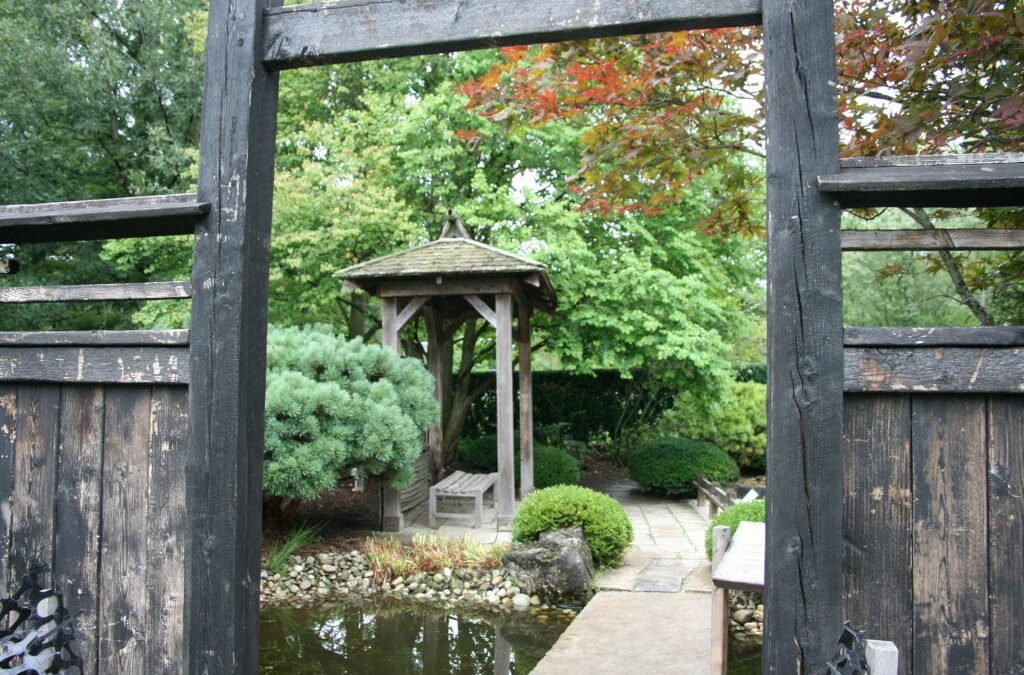
When Sarah and I lived in Guelph, Ontario, we enjoyed walks from our house on Kirkland Street to the Bookshelf downtown, over at the Ignatius Jesuit Centre in the north end of town(where I had a writing studio), and at the Arboretum at the University of Guelph.
At the Arboretum, it was the David G. Porter Memorial Japanese Garden that particularly intrigued me. The garden was dedicated to past Ontario Veterinary College professor David G. Porter by his wife, Mrs. Bobbi Porter, in June 1995. It was inspired by the Zen gardens that the Porters visited during their trip to Japan in 1993. However, because many of the plants that grow in Japan will not grow in the southern Ontario climate, this garden utilizes other alternatives.
The flowers and trees in the Japanese garden include Lawrence Wisteria, Euonymus, Japanese Quince, Merrill Star Magnolia, Aromatic Sumac, Weeping Japanese Cherry, Scots Pine, Dwarf Japanese Yew, and a Katsura Tree.
Landscape architect Christopher Campbell designed the Japanese garden as “the Great within the Small.”
The elements of the traditional Japanese garden inspired me to think of the steps in one’s own tea house or writing practice. Although I haven’t visited the garden in many years, I like to remind myself, and others, of an intentional and nourished approach to one’s writing practice.
The pathway to the tea house could be a reminder to make an appointment with yourself to write in your journal or to continue with a project you’ve been meaning to get back to.
The salutation gateway is a chance to create your own writing ceremony: your own tea house practice. At the gateway, you are on a threshold of leaving your usual routines behind.
Clear a space for yourself at the table as a way to begin, like going into the stillness of the garden.
The Japanese garden is a contemplative garden. How do you practice silence? What will you hear in the silence?
In the Japanese garden, we are to stay on the stepping stones, a path that is both artistic and practical. You can design your own writing path.
A stone bridge crosses a reflecting pool. The water represents a simple lake with a rocky island. Confucius once said that “the wise find pleasure in water.”
I am a floating reed,
waiting an invitation from the water.
Ono no Komachi, 9th century Japanese poet
(translated by Jane Hirshfield)
The Kenninji-Gaki bamboo fence is simple in design and provides a rhythmic balance of horizonal and vertical lines to help block out the world and its confusions.
Think about how you will protect your writing time away from the busyness and distractions of every day.
Ask yourself, what do I have to let go of to create more time for writing?
In the Japanese garden, the spirit rocks may represent mountains or rocky outcropppings. Spirt rocks could be your stories, your own inner wisdom.
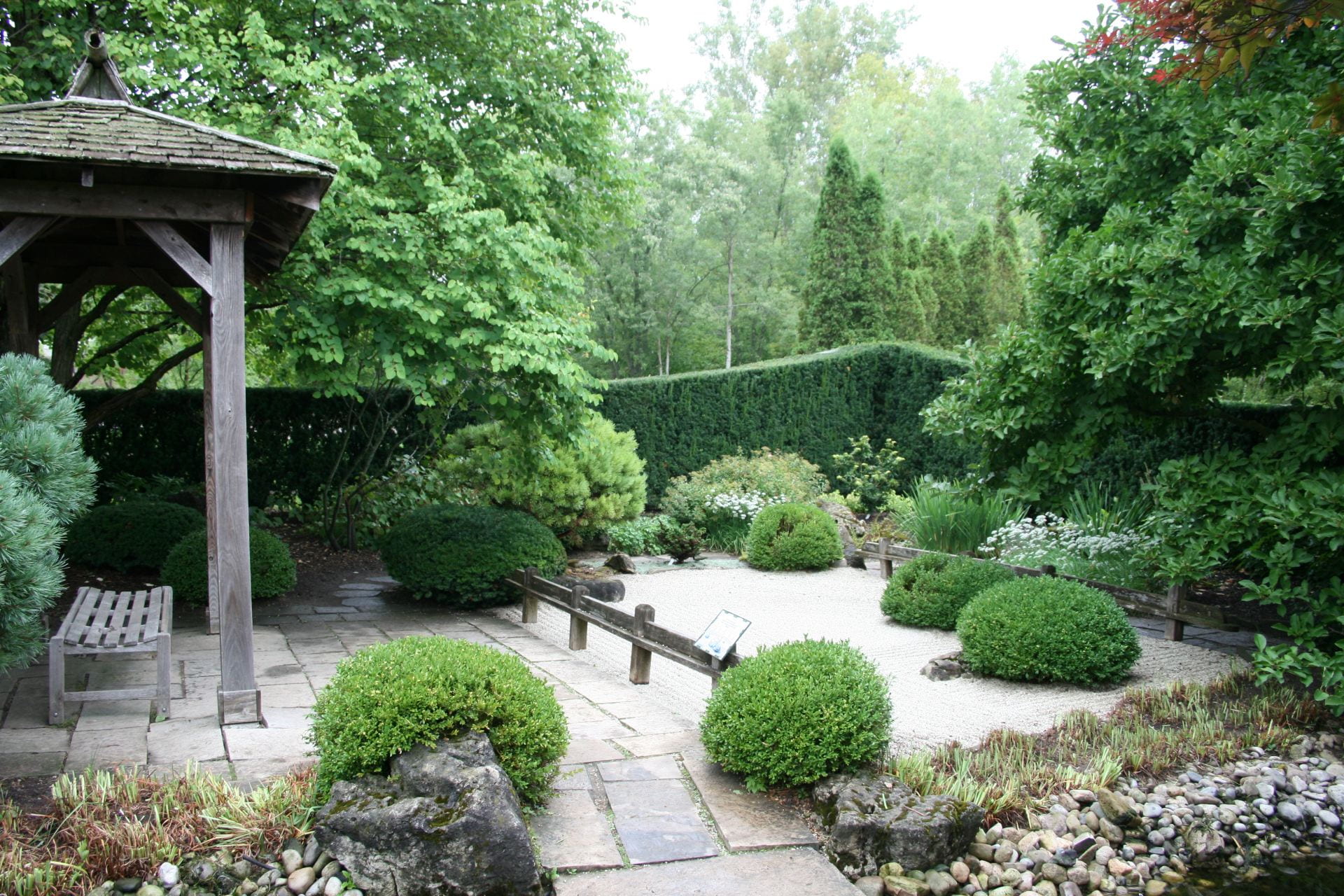 The small tea house represents a small building in a tea garden designed to hold a tea ceremony called cha-no-yu. As an invited guest, you would wait on the bench until summoned by the host. Sitting on the bench, you could take in the surrounding garden such as the dry garden of gravel representing a body of water with three islands. The pattern of raked gravel mirrors the rippling water in the pool.
The host, or tea master, would enter the tea house and make the tea in front of the guests, slowly and gracefully, simple and direct.
A Zen monk named Shuko (1423-1502) designed the tea ceremony to include four cardinal rules:
Urbanity – be elegant and refined;
Courtesy – be polite and considerate;
Imperturbability – be calm; and
Purity – be free from physical or moral pollution.
The atmosphere is meant to allow guests to attain serenity and harmony of spirit. The guests then focus on a certain topic such as a painting, a flower arrangement, or an art object to try to better understand it.
Some steps to think about in designing your own tea house ceremony, a soul-nurturing writing practice that is your very own.
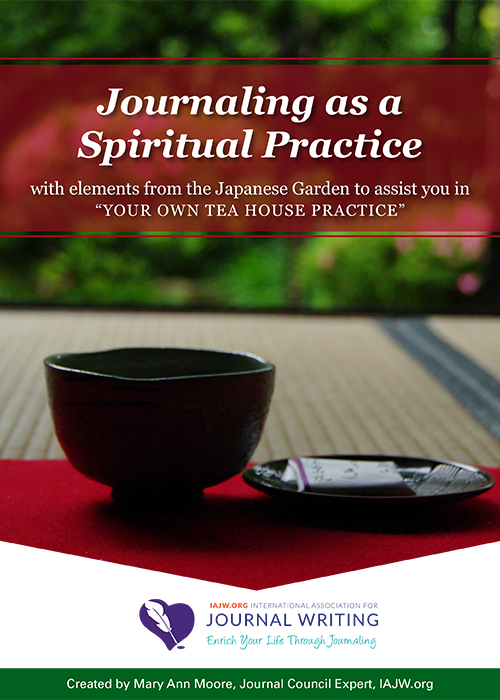 There are more steps, prompts and questions in my downloadable workbook called Journaling as a Spiritual Practice: Your Own Tea House Practice available from the International Association for Journal Writing (iajw.org).
Here’s where you can purchase:
https://iajw.org/journal-writing-products/journaling-spiritual-practice-tea-house-practice/
I experienced a tea ceremony at the Japanese garden in Lethbridge some years ago. I like the way you connect the aspects of the garden and the ceremony to a writing practice.
Thank you Marlene! And thank you for your endorsement of “Journaling as a Spiritual Practice: Your Own Tea House Practice” available through the IAJW.