
I’ve found that writing, using different forms, can reveal epiphanies as something new gets revealed through a different lens. Just last week I offered a women’s writing circle online called “Dwell in Possibility.” We explored fiction or re-envisioning in poetry as well as the anaphora and the hermit crab.
Besides following a particular form, I wonder also about crafting and revising a poem and letting it say what it needs to say. Could that be an epiphany?
I remember my late friend poet Richard Osler emailing me some years ago about our love of John’s Fox’s work with writing as healing and our love of Patrick Lane’s teaching which was about the craft of poetry. Richard said he had sought a middle place. Patrick taught us that in crafting and revising the heart of the poem can be found. Perhaps that’s an epiphany.
Do you have any thoughts about epiphany? I find that doing an acrostic of a word can be revealing.
Here’s mine for the word “epiphany”:
Ecstatic
Peering
Into
Potent
Hypnotic
Arrivals –
Near, not
Yonder
Writing from Epiphany
A few years ago I was writing an essay for Freefall magazine on the subject of fiction in poetry. One of the poets I got in touch with on the theme was Tawhida Tanya Evanson, who is a writer and performer, and a Whirling Dervish, who lives in Tiohtia:ke/Montreal. She told me in an email: “I write from epiphany that is then crafted. The result may want to remain on the page or take another art form. I try not to get in the way. Prayer is part of my spiritual practice. Linking the two would entail a much longer conversation about the essence of prayer and the essence of art.”
You’ll find some of Tawhida’s video poems on her website here.
An Unveiling of Reality
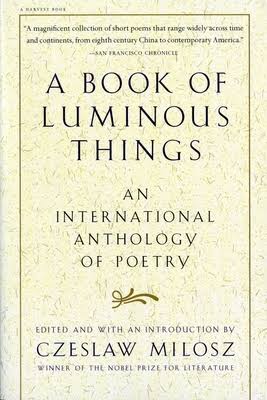
I was fascinated to read what the late Lithuania-born poet Czeslaw Milosz said about epiphany.In an anthology of poems he edited, A Book of Luminous Things (Harcourt, 1996), Milosz wrote: “Epiphany is an unveiling of reality. What in Greek was called epipaneia meant the appearance, the arrival, of a divinity among mortals or its recognition under a familiar shape of man or woman. Epiphany thus interrupts the everyday flow of time and enters as one privileged moment when we intuitively grasp a deeper, more essential reality hidden in things or persons. A poem-epiphany tells about one moment-event and this imposes a certain form.”
Can you recall a “privileged moment” when someone appeared in your life to offer something new or something that really celebrated who you are? It could have been a person or another entity. I’m thinking of a social worker, like an angel, calling to tell me the Children’s Aid had a baby for us. This could have been intuitive grasping, an essential reality, and was definitely an interruption in the “everyday flow of time.”
Epiphanies of a Landscape
Also, on the subject of ephiphany, Czeslaw Milosz wrote in A Book of Luminous Things: “Epiphany may also mean a privileged moment in our life among the things of this world, in which they suddenly reveal something we have not noticed until now; and that something is like an intimation of their mysterious, hidden side. In a way poetry is an attempt to break through the density of reality into a zone where the simplest things are again as fresh as if they were being seen by a child.”
I really do love looking at “the things of this world.” So many poets have done this so well. Jane Hirshfield and Lorna Crozier pop immediately into mind.
Milosz gave a couple of examples of Japanese haiku which, he wrote, “are often flashes, or glimpses, and things appear like lightning, or as if in the light of a flare: epiphanies of a landscape.”
Kikaku (1661 – 1707)
Above the boat,
bellies
of wild geese.
Issa (1763 – 1827)
From the bough
floating down river,
insect song.
Notice, in the haiku above, the translations haven’t followed the five, seven, five syllables “rule.”
Terry Ann Carter says in her book, Haiku in Canada: History, Poetry, Memoir (Ekstasis Editions, 2020): “A haiku attempts to capture the ‘aha moment’ – the moment, not the syllables, is what matters most.”
Whenever Terry Ann composes a haiku about bugs, insects, or small creatures, she says: “I automatically think of the Japanese master poet Kobayashi Issa (1763 – 1827). What a sad life; yet, such beautiful poems about flies, cicadas, snails, frogs, fireflies.”
Keeping in mind “epiphanies of a landscape,” how about you describe what you see outside your window in poems of seventeen syllables or thereabouts.
I mentioned exploring fiction at the beginning of this blog and while we may think we’re “making things up,” it looks to me that we are accessing our own wisdom and insight, an unveiling, as another character perhaps, by opening ourselves to a revisioning of one’s own truth. Perhaps “small fictions,” something poet Eve Joseph has referred to, are like epiphanies helping poets get to an unveiling of truth, when we can accept and surrender to the poem knowing more than we do.
A poem’s truth is not in its accuracy but in its small fictions. What began as a notion of fiction in poetry has become something else, just as happens in the writing of a poem. We start somewhere and end up somewhere else, privileged, one could say, by moments or flashes that interrupt the everyday flow of time.