by Mary Ann Moore | Apr 15, 2022 | A Poet's Nanaimo
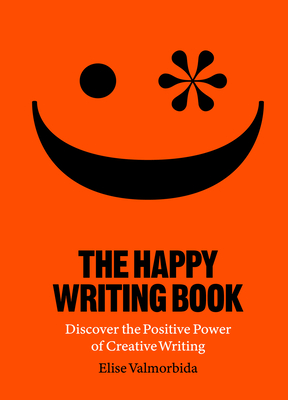
“I feel unmoored when I’m not writing. Incomplete. Not quite myself.” Those are the words of Elise Valmorbida, author of The Happy Writing Book: Discovering the Positive Power of Creative Writing (Laurence King, 2021).
I definitely relate to what Valmorbida says above, included in her book that is the result of “decades of deliberation and discovery about the art, craft and positive experience of creative writing.”
Valmorbida, who grew up Italian in Australia and lives in London, has been a designer and creative director as well as the author of several books. She continues to teach Creative Writing through various organizations, at literary festivals and community-building organizations.
The Happy Writing Book (not designed by Valmorbida) has a very cheerful design with its orange cover and the large orange numbers that introduce each chapter.
In “Write What You Know?” Valmorbida says “your own experience will inform your work” but points out that authors do research. In the case of Annie Proulx, she “writes what she knows, but she didn’t know it before she started delving.” That delving sounds fun as Proulx “takes herself to new places, haunts little stores and buys heaps of second-hand books about farming, local history, auction records, hunting tackle, whatever. She transcribes wording from street signs and menus and advertising. She hangs about and absorbs conversations, noting the speech patterns, the vernacular, topics of concern.”
“Write to discover what you want to know, Valmorbida says. I like that approach and find it much more fascinating to learn as you go rather than to describe something you already know. Of course, you can write what you remember and approach it in an inventive way. There are many fine examples of doing that including a couple of memoirs I’ve read recently: Safekeeping by Abigail Thomas (considered a “fractured” memoir due to its short chapters written as vignettes from a life) and a more recent book, Persephone’s Children by Rowan McCandless (considered a “mosaic” memoir with the various forms of personal essays used by the author).
In a chapter about procrastination, Valmorbida suggests joining a class or making a circle. Circles can take different forms such as one to share work and get some feedback on your work from fellow writers. (Thank you Easy Writers with whom I worked for years.) You can form a circle where you get together to write and share your work, focusing on what most resonates with each listener. If you need some confidence building and aren’t out for impressing publishers, this is the way to go. (This is the approach taken in the Writing Life women’s writing circles I lead.)
In her chapter entitled, “Keep A Diary,” Valmorbida says “Don’t attempt to write out your entire day, every day.” I do, especially lately, as it’s a grounding exercise for me. I like her suggestion though of choosing a theme – “just one strand of experience – say, the music you’ve been listening to, where and how you heard it, what effects it has on you. Or you could focus on the places you’ve been to, physically and imaginatively, and see what thoughts take shape in your writing.”
That approach sounds like you could end up with some prose poems or short pieces of life writing that describe a year in your life. Recently I picked up a copy of The Book of Delights by Ross Gay in which in wrote about delights or “small joys we often overlook” each day for a year beginning with his 42nd birthday.
Valmormida says: “If you do only one thing in the diary department, I urge you to try your hand at this: gratitude. Make a regular record of the day’s blessings: a pleasure experience, a kind gesture, an accomplishment, a loved one, a smile, a gift, a moment of beauty.”
It’s a grand way to sleep at night “with a smile in your mind, and your dormant body will be suffused with benevolence.”
Studies show that, over time, this positive writing ritual can lower stress and anxiety levels, while boosting self-confidence, clarity of thought and resilience. In other words, you could be writing yourself happy.”
While publication can be a thrill, Valmorda says, “If you want to be published, you’ll be happier if your desire to write is greater than your desire to be published.”
I agree with that. “The point is to write,” Valmorida says. “The joy is in the doing. Discovering yourself, word by word. Unearthing ideas, word by word. Try creating without regard to result. Enjoy the process, how the practice of writing subtly makes its way into how you’re living. Your writing, like your life, is a work in progress.”
And you can always re-envision a situation as you write. In her chapter entitled “Invent an Alternative Present,” Valmorbida says: “You can rewrite the present with the hope of making things better. And – who knows ? – such action may even succeed in making things better.“
I believe that what we write can draw situations to us. Writing can be powerful. People have said they wrote in their journals about situations they’d like to improve and without realizing until some time later, they drew to themselves the home, the relationship, the job they were desiring. There’s also prescience in writing so that we write about a situation long before it comes to pass. I even did that in a collage (done in about 2015) with an image of a house that looks very much like the one we live in now.
Valmorbida says in her chapter, “Write the Future,” that John Updike “commented on the frequently prophetic quality of his fiction, to the point where people would appear in his life who’d started out as fictional characters. Reality eventually acts out our imaginings: when we write, we do so out of latency, not just memory.”
A good suggestion in the book is to write out the negative and positive. The “negative” could be the emotions related to traumatic events. Valmorbida notes the work of James Pennebaker who investigated the effects of “expressive writing” and found that it led to an improvement in various physical symptoms and immune function. So writing about your “deepest thoughts and feelings can lead to better health – and notably fewer visits to the doctor.”
As Valmorbida says, writing about negative experiences or “vexing” people “doesn’t take the vexations away, but it does take away some of the sting.”
Virginia Woolf, in her autobiographical essay, “A Sketch of the Past,” referring to a “shock,” wrote: “It is only by putting it into words that I make it whole; this wholeness means that it has lost its power to hurt me; it gives me, perhaps because by doing so I take away the pain, a great delight to put the severed parts together. Perhaps this is the strongest pleasure known to me. It is the rapture I get when in writing I seem to be discovering what belongs to what; making a scene come right; making a character come together.”
Woolf has connected the pleasures of writing therapeutically and writing artistically. Valborbida says of her own fiction writing that while writing her last novel, “I felt a general sense of satisfaction, commitment and purpose, a quiet inner anchoring – even during difficult times.”
I appreciate the term “inner anchoring” which I find applies to writing in a journal every day and in writing a poem about what one observes in the moment.
Elise Valmorbida says “Be interested in everything, Read everything. Learn something from everything.”
Number 100 in her book is “Write Now.” “ Now is the beginning of the future. The quality of your now affects the quality of all your future nows. Now is the most important time of all.”
by Mary Ann Moore | Mar 25, 2022 | A Poet's Nanaimo
I asked the women in the Writing Life circle, what’s in the middle? It was the first writing circle of a six-week series with the theme of “Piecing Our Stories from Life.” I had quilts in mind when I came up with the theme of “piecing” and quilts always start in the middle.
The women in the Writing Life circle have written together, in the past, for weeks and some for years. I wondered what they thought was in the middle of the writing they had done in the past. What did they think was a recurring theme.
As I write along with the other writers, I thought of the “middle” of my own writing. It’s interesting to approach the question by answering it in the third person as then you can have some distance and some insight about this particular writer whose work you have read (who just happens to be you).
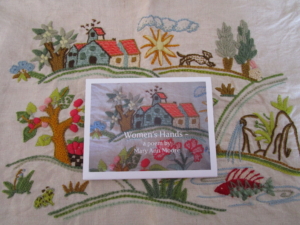 I wrote: Mary Ann Moore writes about peonies in her grandparents’ garden, her first grade school teacher, a fresh radish from the vegetable patch. It’s life’s ordinary pleasures that appear to bring her joy. Even while travelling in Greece or Turkey, Mary Ann notes the oregano on feta, a circle of women telling stories. There is a spiritual aspect – the muezzin’s call to prayer, the sanctity of the Hagia Sophia, the sarcophagus of the poet Rumi with its gold Arabic calligraphy. [Photo of crewel work by my mother, Billie, with cover of poem called “Women’s Hands.”]
Planting seeds in the field of a Turkish eco-farm takes her back to sitting by the cucumber patch with her grandfather, his cutting of a fresh cucumber slice with his pocket knife.
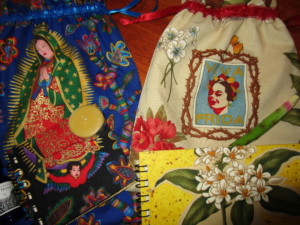 Mary Ann links the Ottawa Valley to Turkey and includes the Mexican artist Frida Kahlo at times perhaps for her determination to create despite the physical odds against her. Or it may have been her painting that kept Kahlo alive and Mary Ann reflects on the creativity of women with her grandmother’s quilt, her crocheted doilies and the work of other women whether in a traditional Greek cloth bag woven in patterns of red or a killim created by village women. [Photo of cloth bags made with images of the Virgin of Guadalupe and Frida Kahlo.]
The fact that certain languages don’t have a word for “art” fascinates Mary Ann and is at the middle of her explorations.
The people of ancient Crete made pithos jars to hold olive oil, decorated them with carved flowers and leaves.
In a jam jar on the oil cloth covered kitchen table of her childhood was a bouquet of buttercups and daisies.
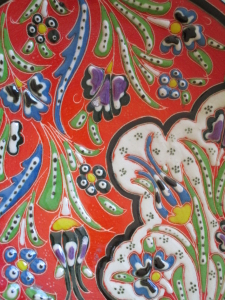 The beauty of everyday objects, her relationship with the plant world and to her ancestors, connects this writer to a magnificent spiritual system. [Photo of detail of Turkish, hand painted plate.]
Does the “spiritual system” have a name?
God?
Goddess?
Tea cup?
Peony?
Prayer?
by Mary Ann Moore | Mar 15, 2022 | A Poet's Nanaimo
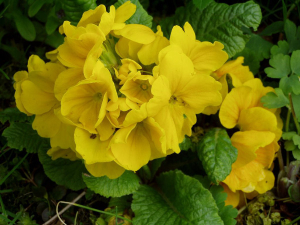 It’s spring here on Vancouver Island with crocus, daffodils, primulas, hellebores and other colourful flowers in bloom. Winter was a challenge as we had more snow than usual (and we’re not prepared for that out here) and Sarah and I learned in December that the house in which we’d rented the upper level for seventeen years was being sold.
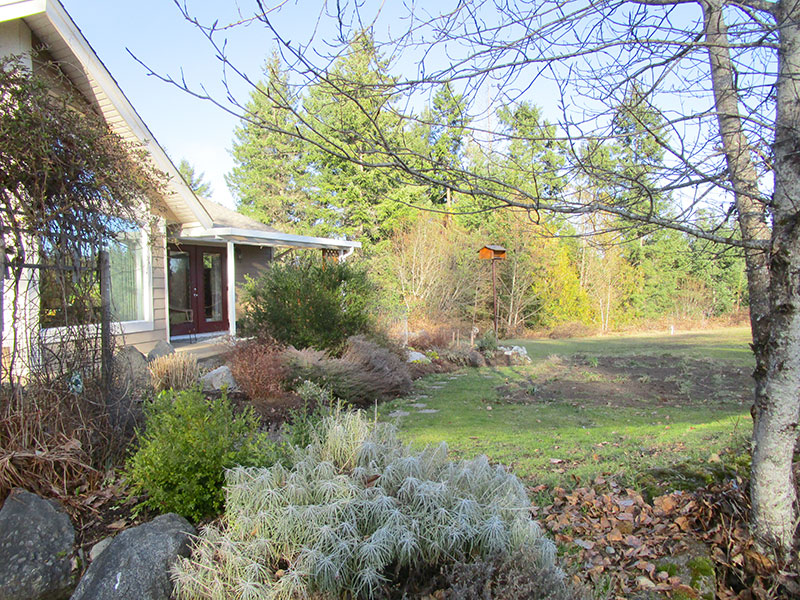
Packing is tiresome on its own and to that, I decided to go through everything, letting go of books, many journals, notes, and other papers filling files. There are still photo albums to pare down which I’ve inherited from my great aunt, aunt and uncle, and father. I’m now at the stage of putting things away in a beautiful home, also a rental and all to ourselves, about fifteen minutes south of Nanaimo. [The photo shows the end of the house where Sarah has her studio and she and our younger cat, Izzy, can go out on the deck.]
Sarah and I are very grateful to have found such an amazing place. We thought we had to seriously “downsize” and this place is bigger. We’re appreciating the quiet of being out in the country and the space around us. We’re on five acres along with the owners’ house and we’re feeling expansive in various ways. We’re also feeling the challenges of an adjustment and look forward to the days when our surroundings feel comfortable and familiar. It’s getting like that more and more every day. (We’ve been here two weeks now.)
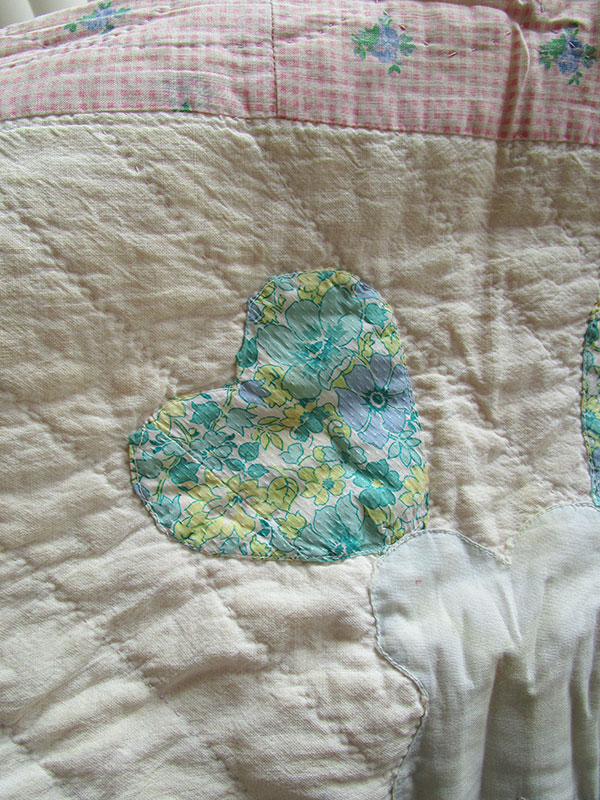
 As I unpacked the linen closet items, I came across a quilt my grandmother made with other quilters in the 1950s. They sat around a quilting frame, sharing stories as they pieced and stitched.
The quilts became stories too as fabric, ribbon, and other fragments turned into works of art and of practicality. The pieces creating the pattern of hearts in my grandmother’s quilt are from her cotton housedresses, already faded. The backing is made of bleached flour sacks. I have always loved quilts and this particular one is full of the memories of my early life with my grandparents in Eganville, in the Ottawa Valley, Ontario. I expect I used it on my bed when I was a kid and here we are sixty-five or so years later.
The women quilters were “piecing” which is similar to what we do when we write, stitching scenes from memory that may become part of a larger work. I think it is a good metaphor for the next six-week Writing Life circle which will begin on Wednesday, March 23. We’ll gather in person at my home in Nanaimo as if around the quilting frame, in a circle to write and share with the theme of “Piecing Our Stories From Life.” You’ll find further info here.
Writing was the healing place where I could collect the bits and pieces, where I could put them together again. It was the sanctuary, the safe place.
from Remembered Rapture: The Writer at Work by bell hooks (1952 – 2021)
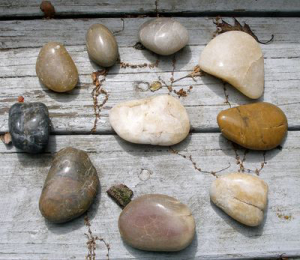 As several of us have discovered, we can connect to one another by sharing our stories by email. For those of you not able to attend a Nanaimo writing circle, I’m offering a circle “from away” via email called “Our Stories and How They Connect Us.” It begins Thursday, March 24.
For some, it’s actually more comfortable to express themselves through the written word only. You may have discovered that through writing letters to someone and finding out more about yourself and your pen pal as you do so. Several women were part of the circle “from away” in the past and I hope we can rekindle those connections. You’ll find more information here.
On occasion, I’ll offer individual writing circles via Zoom. Back in the spring of 2020, I didn’t think offering women’s writing circles via Zoom would work or offer the same depth of writing and sharing experience. As it turns out, Zoom has been a very helpful partner in offering circles so that we can stay connected by following the same guidelines we follow in the in-person circles.
I wish you a Happy Spring, clearing away what no longer serves you which may include, as the days go by, an easing of restrictions imposed during the pandemic. Think of the babies and toddlers who won’t have seen many faces and will now be able to see us un-masked. So many stories to share of our experiences of the last two years, the hardships, disappointments and the many gifts.
by Mary Ann Moore | Feb 27, 2022 | A Poet's Nanaimo
Sarah and I have never lived anywhere for seventeen years, in the same house that is, together or apart, before the house in which we’ve lived in Nanaimo.
Now we’re on the move to another home in Nanaimo, about fifteen minutes south of downtown, and I’m thinking of all I’m appreciating about our current home – for just one more day.
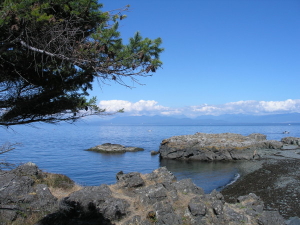 We arrived in Nanaimo, B.C. from Guelph, Ontario with our four cats in May of 2005. We had a few suitcases with us but that was it until our furniture and other belongings arrived about a week later. Life was very simple with so few belongings. Our landlord Peter loaned us laundry baskets full of linens, a mattress, a lamp, dishes and cutlery. I can’t imagine now being without my computer for a week! Sarah painted the bedrooms and we’d take little jaunts out to get to know our new city. Neck Point, just seven minutes from our home, was a favourite spot where we looked towards the Sunshine Coast of the mainland.
Our rental was to be temporary as we looked for a house to buy. I don’t remember ever looking for a house once we landed here. Or perhaps, we did occasionally. We got very comfortable and were treated very well in our rental home.
Our rent was affordable. Buying a house with its upkeep would mean “jobs” and why spend time elsewhere to buy a house that you can’t spend much time in? We stayed with our art making and graphic design, in Sarah’s case, and freelance writing, poetry and writing circles, in mine. Besides, Peter has been a landlord extraordinaire. He continued to work in his wonderful garden that is terraced with three ponds and a waterfall. The vista from our living room is of the Grandmother of All Surrounding Mountains, Te’tuxwtun to the Snuneymuxw people, and the mountains south of Nanaimo. We could watch the phases of the moon and the many aspects of the sky throughout the day and evening. In our front courtyard, we could sit under the mulberry tree and hazelnut, chatting with friends perhaps.
Peter liked to dry herbs from his garden, make tomato juice, salsa, and strawberry jam and share his prime rib roast with us. We were never without surprise treats of dinner or lunch. Oh, and there was Christmas with spiced nuts and bolts, shortbread cookies, butter tarts and a turkey dinner if he happened not to be in Mexico. (We had our last Christmas dinner in December 2021.)
If ever we ran out of anything, the stores were close but Peter’s pantry was closer!
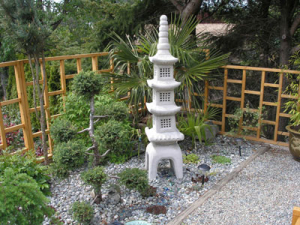 The four cats we brought with us have all died: Miss Pooh, Kadi, Simon and Qwinn. We’re leaving their ashes here, in the Zen garden at the top of the driveway, and their spirits are always with us so they’ll be coming along to our new home in the country. And we’ll be taking Squeaker and Izzy with us, both very much alive. And so far, weathering the transition very well.
I wrote Writing Home: A Whole Life Practice here and Writing to Map Your Spiritual Journey was made into a digital format. I published poetry in various publications including chapbook anthologies edited by Patrick Lane, my own chapbooks, and a full length book of poems (Fishing for Mermaids, Leaf Press, 2014).
Other writing was in the form of advertorials for the Nanaimo Daily News, articles for More Living magazine and Synergy, book reviews for the Vancouver Sun and other publications.
I mention all these things as I’ve been going through files of clippings going back to the eighties. I do have some folios of articles I’ve written but those ancient files have been recycled. So many journals have been shredded as I ready myself to carry the memories although not in physical form. It’s time for a fresh new chapter for both Sarah and me.
It’s been wonderful to be part of a writing community on Vancouver Island. I started meeting writers right away when I attended the Victoria School of Writing and began going to poetry retreats with the late Patrick Lane. Connections made there with other poets have continued.
 I appreciated WordStorm monthly poetry events in Nanaimo co-founded by David Fraser and Cindy Shantz. I joined a group with them and other writers, calling ourselves the Easy Writers. We had such fun going to Poetry Gabriola as a group meeting the likes of Robert Priest, Richard Van Camp, Ivan Coyote and Sheri-D Wilson.
At home, I started offering women’s writing circles called Writing Life (a continuation of the Flying Mermaids circles I had offered in Ontario) and I held salons for friends who had new books: Laura Apol from Michigan, Arleen Pare from Victoria, Alison Watt from Protection Island, Diana Hayes from Salt Spring Island, and Leanne McIntosh from Nanaimo. I think I had a salon way back when for Tina Biello and we did other readings together as our poetry books had come out at the same time.
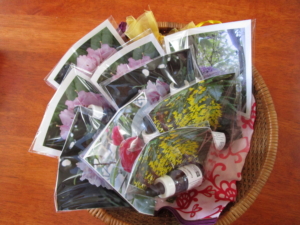
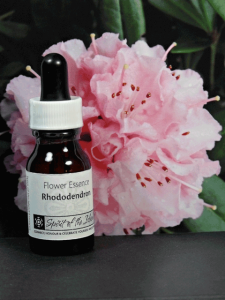 I made flower essences in the garden here starting with Rhododendron, the definition of which is Self-Trust. Spirit of the Island is the name of the flower essence series, a name Sarah and I came up with together. Another of the Spirit of the Island flower essences is Camellia: Be Here Now. It is a photo of the camellia that attracted our new landlord to read Sarah’s post re looking for a place to live.
Since the house was sold in December (we’ve been renting the main level suite), we’ve been letting things go. We’ve made several trips to the Haven Society thrift store and to Well Read Books, Literacy Central’s bookstore. And I’ve given many books away to women in the circle circle. Still, there are many books to pack. We’re at a stage now that we want to take with us what will support our new phase. We’re not sure what that will look like but we’re grateful we have found a beautiful rental home in the country. Our new home will have lots of room including studio and office space, a garage and five acres on which to roam. The owners also have a house on the property. Annemarie is an avid gardener which is what attracted her to the camellia.
Thinking ahead to our new home has kept us going during these final days of packing as well as appreciating all we’ve enjoyed here.
A faded garden flag
empty flower pots
a tiny temple under the ferns
by Mary Ann Moore | Jan 14, 2022 | A Poet's Nanaimo
So many people passed on in 2021 including many poets and writers we’ve come to love through their work. I so appreciated Lee Maracle’s work in the world and had the honour and delight of working with her during the summer of 1993. Since hearing of Lee’s death on November 11, 2021, I’ve been thinking of the two weeks spent at West Word IX, a women’s writing retreat held at a college campus in North Vancouver, B.C.
All these years later, obviously, the two weeks at women’s writing retreat had a huge impact on me and I expect, others who attended Lee’s fiction workshop. I think the poets and the creative non-fiction groups may have been envious of all the fun we were having.
Lee had us walking on the desks in our portable classroom so as to have a fresh perspective, and some fun, and we took walks through the woods near the college, together. We all continued to learn from her as we hung out at meals or in the evenings. I first learned “muscle testing” from Lee and I still remember her advice about keeping hydrated so as not to pick up all the energies in a room full of people.
When people spoke of women getting the vote (in 1922 with some provinces earlier than that and Quebec not until 1940), Lee pointed out that was the vote for white women. It was not until 1960 that “suffrage” in federal elections was extended to First Nations women and men “without requiring them to give up their treaty status.” (The quote is from Wikipedia.)
Lee did not think much of writer Margaret Laurence nor artist Emily Carr. I have had different views of Laurence and Carr since then.
Margaret Laurence wrote of a First Nations male character in The Diviners who Lee felt was depicted in a degrading way. In her 2020 Writers Trust lecture, named for Margaret Laurence, Lee noted The Diviners and “the violence of the dirty halfbreed” as he was described and depicted, and the daughter in the book being prevented from seeing her father (who was the First Nations man.)
In the Writers Trust lecture (which you can find on line), Lee said she was grateful to be honoured. She said she cherished Dionne Brand who says “no language is neutral.” Lee, who was a member of the Sto-lo Nation on British Columbia’s coast, said every word originates in a body and is a salutation to the skies.
While people have “reclaimed” language such as “dyke” and “queer” for instance, Lee said reclaiming the terms “squaw” and “halfbreed,” would fail to become positive. She could feel such an act “dismantle” her being.
 Lee wasn’t in favour of “deleting history” but she was against people reading about themselves as the subjects of degradation. She suggested we explore racism in literature. She included Mark Twain in that category.
As for Emily Carr, I remember Lee talking to Susan Crean, who was leading the Creative Non-Fiction group at the writing retreat in 1993. Susan was writing a book about Emily Carr, the artist Lee called a racist. I had a look again at Susan’s book, The Laughing One: A Journey to Emily Carr (HarperCollins, 2001) to remind me of that time as Susan wrote about her conversation with Lee.
At a public reading by the writing retreat instructors that was taped and broadcast on Co-op radio, Susan read from some of her notes “for an article on Emily Carr.” Susan was followed by Lee Maracle, reading from her book Ravensong. “Afterward she [Lee] delivered a stinging rebuke of my appropriation of her people’s stories, commingled with an elegiac prayer for her ancestors.”
Lee was always direct but it didn’t mean she dismissed people altogether. When Susan sought her out after breakfast the day following the reading, Lee “wasn’t angry or unfriendly,” Susan says in her book. “I even asked her why, given history, Native peoples tolerate the company of Whites.”
“She [Lee] shrugged and told me that my faux pas didn’t change the fact we were friends. As for Emily Carr, she guessed it was my choice if I wanted to rehabilitate a racist.”
Susan refers in The Laughing One to a “controversy” that had erupted in the spring of 1993 with the publication of an analysis by Haida/Tsimsian art historian Marcia Crosby regarding Emily Carr’s portrayal of Native peoples and “other White settler society.”
Crosby’s work said that “Carr’s knowledge of Native culture was fragmentary and minimal,” even though as Susan writes, “a special emotional attachment might be conceded.”
Many people have said of the art by white artists portraying First Nations villages, artifacts, and sacred ceremonies that they are preserving a culture that needs to be “saved.” As Crosby wrote: “[Those] doing the saving choose what fragments of a culture they will salvage. Having done this, they become both the owners and interpreters of the artefacts or goods that have survived.”
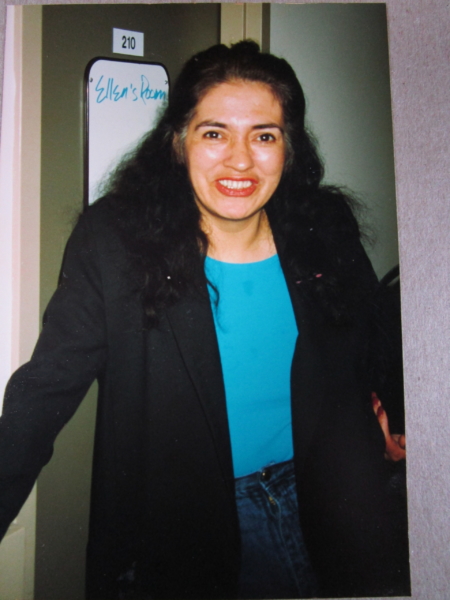
[Photo of Lee Maracle by Mary Ann Moore, 1993]
One day in our fiction group at the retreat in 1993, a woman of colour suggested the other Black, Indigenous and women of colour meet together. One of the white women thought we should all stick together not realizing the strength and solidarity the BIPOC women would gain by meeting on their own. I had the good fortune of having some anti-racism training through the Toronto Rape Crisis Centre where I had been a volunteer so suggested the white women meet in a group as well to discuss our part in adding to the unease and lack of safety for the BIPOC women.
We white women met on our own and heard the story of the woman who had been opposed to the BIPOC gathering. It was from that experience I learned that people don’t listen until they have had their own stories heard. I’ll call the woman Irene, the one we listened to about her family’s involvement with Nazis. It was shocking and although we had listened to Irene’s story, she chose not to stay for the second week of the retreat.
I learned lots at that retreat in 1993 including how writing is about all of life. I described some of my learning in my book Writing Home: A Whole Life Practice.
I recalled getting the letter of acceptance from West Word IX, the women’s writing retreat organized by volunteers, and taking it to the law firm where I worked as I was so excited about the good news. I would be spending two weeks of my vacation writing with other women. I was up for the challenge.
At the retreat, we had morning workshops with afternoons free to write, take a walk, have a massage. There were often spontaneous gatherings to share our work and there was also lots of play. We’d leave notes on one another’s room doors describing imaginary, playful gatherings.
I made changes when I got home to Toronto so that I could spend more time writing. I told my employer that I could do my job of scheduling in three-and-a-half days a week and they went for it. I think I had already moved to a cheaper apartment closer to work so I didn’t have transportation costs.
As I recall the community we created at West Word IX, I remember:
We met daily in a circle.
We each had a voice.
We told our stories.
We received wise guidance from an elder/leader.
We spoke through tears.
We “played” which gave us a different view of the situation and the world.
We “slowed the picture down” which was one of Lee’s pieces of advice about our writing.
We took a walk together seeing life’s lessons in Nature.
We acknowledged spirits, ghosts, and the energy of the land.
We ate meals together and shared our experiences of the day.
We had a room of our own to connect to ourselves and to write.
We had impromptu readings of our work.
We got silly.
We dealt with issues such as racism when they arose.
We honoured ourselves in readings of our work to which we invited others.
I was glad to be able to see Lee again a few times after we went home to Toronto, from the retreat. She joined me and other new friends from the writing retreat at a lesbian bar one evening. She did the same in Vancouver when we went to Lulu’s. It’s funny that I remember one of the songs we danced to in a circle: “Rhythm is a Dancer.”
We were excited, in emails, about my book launch in April, 2014 when Lee was actually going to be on Vancouver Island. We weren’t able to make the connection in person but was grateful for our mutual enthusiasm for our connection, however we could make it.
Thank you Lee for your witnessing, your speaking up, your passion, your writing, your teaching, your support, your speaking up. And for telling me I was the bravest white woman you had ever met and you estimated you had met about 10,000 white people at that time. Your encouragement was, I expect, the impetus for me to return to Vancouver in 1994, rent a car, and drive to Lytton where my great uncle had been principal of St. George’s Residential School in the late 1920s and early 1930s. My research, writing and acknowledgement continues.
. . .
We have lived for 11,000 years on this coastline
This is not the first massive death we have endured
We girded up our loins,
Recovered and re-built
We are builders,
We are singers,
We are dancers,
We are speakers
And we are still singing
We are dancing again
. . .
From “Blind Justice” by Lee Maracle (2013)
by Mary Ann Moore | Dec 30, 2021 | A Poet's Nanaimo
We poets had a beautiful tradition at Glenairley in Sooke, B.C. on Friday evenings at our retreats when the Jewish women said prayers and sang songs, lighting candles as sunset approached for the beginning of Shabbos. One of the women was Isa Milman from Victoria, B.C.
Glenairley, an old farmhouse in Sooke, was an early location for poetry retreats with Patrick Lane. They had been running for several years before I began going in 2006. I was glad to meet Isa there and many other poets to whom I’m still connected.
Isa Milman is the author of three collections of poetry: Something Small to Carry Home (2012); Prairie Kaddish (2008), and Between the Doorposts (2004). She’s a three-time winner of the Helen & Stan Vine Canadian Jewish Book Awards whose jury in 2012 called Isa “a foremost Canadian writer of Jewish themes.” Besides writing and university teaching, Isa’s professional life has encompassed occupational therapy practice, entrepreneurship and art-making such as quilt making and collage.
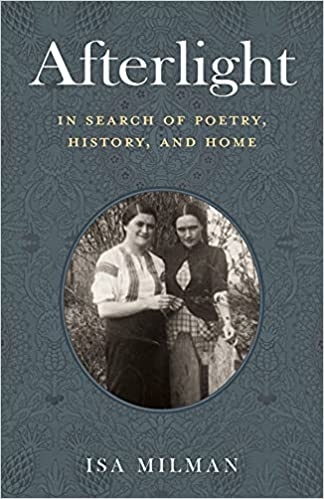
In 2013, Isa began writing her memoir that came out in the Fall of 2021: Afterlight: In Search of Poetry, History, and Home (Heritage House). Her memoir is a family story as well as the lesser known story of “a holocaust of bullets” in Eastern Europe. Jews were shot and thrown into pits dug by local people “to get rid of Jews” or pressed into abominable service by the Soviets when Hitler and Stalin took over Poland. (Quotes are from Isa’s interview with Kathryn Marlow on North by Northwest, CBC, October 16, 2021).
As Isa says in Afterlight, “In all thirteen thousand Jews were murdered in the district of Kostopol – local Jews, and Jews brought from neighbouring towns.”
Afterlight is composed of chapters about what Isa knew of her family history told as if in an unfolding present interspersed with chapters where readers learn as Isa learns and does research including travelling to Poland and immersing herself in Polish Jewish history and poetics. I so appreciate the sharing of her journey as a poet and writer digging into the lost history of her family.
Sabina, Isa’s mother, had withheld some horrible details but had told her children about the murders of her twin sister Basia, Basia’s two-year-old son Mordechai Fishman, ripped from her arms, and other extended family members. More stories came out in the last year of her life, while living in New London, Connecticut.
“But in her newly awakened state, just steps away from the threshold to the next world, my mother returned with a story of her childhood with Basia. She told of her twin’s brilliance, her love of poetry and history, and her desire to write a book when she was only fifteen.”
As more stories were revealed, Sabina Milman said: “Isa, write this down, this should be your next book!”
Isa did jot down her mother’s words to which she would refer several years later. (Sabina Milman died in April 2007.) The photograph on the cover of Afterlight is of Sabina and Basia Kramer in Warsaw (Praga), Poland circa 1937.
Isa’s research and travel opened her up “to the complexities of how we understand history,” she said in her interview. Her memoir is “deeply rooted in the facts of the history that I tell,” Isa says in her introduction, and “it’s an exploration of imagination” as she creates scenes and dialogue as she envisions them. The book really is a marvel.
There’s also a mystery to be solved: Isa wants to learn more about her mother’s twin sister Basia who published poetry when she was fourteen, and was murdered in 1942 when she was twenty-five.
I found it heartwarming to read that Isa’s husband Robbie accompanied her to Poland where she was to present at a conference about Jewish-Canadian-Polish cultural connections in April 2014.Originally, he hadn’t want to go as nothing attracted him to Poland “not even the food.”
Robbie said: “I’ve been watching and listening as you prepare for this trip, and I think that doing it alone is a bit more than you should take on by yourself.”
Robbie, whose full name was Robert Brooke Naylor McConnell (1942 – 2019), was a fourth generation British Columbian. Afterlight is dedicated to him, Isa’s children “and theirs.”
 It was also heartwarming to read of the various connections Isa made to Poles, Ukrainians and Jews in her research and travels.
Isa’s parents, Sabina and Olek Milman considered themselves lucky, she said in her interview. They were deported to Siberia, spending twenty-six days in a cattle car enroute to Itatka, “the second-to-last stop of this railway line, the farthest prison camp of the Soviet gulag,” she says in the book. [Photo of Isa Milman by Shea Lowry]
The Milmans did have some luck and synchronicity along their arduous journey, before and during their deportation. In early 1943 when they were sent to Uzbekistan, Sabina met a young Russian soldier on the journey. They conversed in Russian when their paths crossed, heading in different directions. When the soldier heard the Milmans were headed for Fergana he said his parents lived there “. . . and they would be overjoyed to receive word from me that I’m alive and well.” More than fifty years later, Sabina remembered the address on Vtoraia Ulitsa (Second Street).
Isa writes that “Once again, my mothers’ treasure chest of languages, and her natural friendliness and warmth, opened the door to the next chapter of my parents’ survival.”
Afterlight is a healing journey with its references to crimes against humans by fellow humans, Isa’s shedding of tears on the site of atrocities in Kostopil, and the blessed connections that can be made with survivors and allies. There is much to appreciate and honour in Isa’s story of uncovering the sorrows and the joys of her family. She, along with other Jews, is a member of “an ancient global family” as Rabbi Rami Shapiro has said in one of his magazine columns.
When Polish poet, Tomasz Rozycki, was visiting Victoria, Isa asked him if he had heard of “Tikkun – this beautiful Jewish concept of repair.” He shook his head and Isa told him: “This is our task on earth, to heal what’s broken, to make it a little better. It’s the most we can hope for.”
Among the amazing family photos included in Afterlight is one of Sabina, Olek and their daughters Estera and Isa Milman leaving Germany in May of 1950, where both girls had been born in DP camps.
The word “afterlight” is one Isa discovered and found to be the perfect title for her memoir. “Afterlight is an uncommon word that refers to the light visible in the sky after sunset, or to a look back in time, a retrospect,” she writes in her introduction.
The book is timely as Isa said in her interview. Hatred and genocide still exist. People are still displaced from their homelands. “What can we do as human beings to make it a little bit better in this world?” she asks.
